Destination Wedding Guest Logistics
Destination Wedding Guest Logistics

A destination wedding invitation gives you the date and location, but it may leave the practical route unresolved: where you should arrive, how far the venue is from that point, where to stay, how local transport will work, and who to contact when plans change.
For a Colombian or Colombian-diaspora wedding, plan the journey as one connected route rather than a set of separate bookings. Review current entry information, compare the route to the actual venue, arrange regional movement, choose accommodation around the wedding schedule, and confirm each handoff with the person or institution responsible for it.
Details can vary by nationality, travel document, carrier, region, venue, timing, and wedding format. The framework below helps you identify those variables; it does not replace current confirmation from the relevant authority, carrier, accommodation provider, venue, transport provider, couple, or planner.
Start With the Actual Wedding Venue
A city name is not the same as a venue location. The wedding may take place in a nearby municipality, on a rural property, in a coastal area, or at a venue reached by a further road journey. The route that looks simple on a map may not fit the ceremony time, group transport plan, or accommodation arrangement.
Before comparing flights or hotels, ask the couple or planner for:
- The full venue name and address
- The municipality or region where it is located
- The expected arrival and departure dates
- The ceremony and reception times
- Whether both events take place at the same venue
- Whether guests are expected to stay in one area
- Whether group transport will be arranged
- The preferred arrival area or meeting point
- A contact for arrival-day questions
This information lets you compare the entire journey with the wedding schedule. It also prevents a common misunderstanding: accommodation that is convenient for an airport or sightseeing may be inconvenient for the venue.
A booking platform or destination website can help you research possible areas. It cannot establish that a particular hotel, route, or transfer fits this wedding. Wedding-specific timing, pickup points, venue access, and transport instructions should come from the couple, planner, venue, or provider responsible for them.
Keep Entry Checks Separate From Wedding Arrangements
An invitation confirms the event, not each guest's individual entry process. Requirements and procedures may vary according to nationality, travel document, transit points, current policy, and the purpose or length of the trip.
Check current information with Migracion Colombia and any relevant government travel-information service before making final assumptions. Review the details that apply to your own journey, including:
- Whether advance authorization or another travel document may apply
- Which documents and records the relevant authority currently discusses
- Whether transit through another country changes the process
- Whether your travel document meets current conditions
- Whether information has changed since the invitation was issued
- Whether your itinerary, nationality, or travel purpose differs from other guests
Do not use another guest's experience as evidence that the same process will apply to you. Different routes, nationalities, documents, and travel circumstances can lead to different questions. The available source material supports using the migration authority as a confirmation route; it does not establish an outcome, document sufficiency, eligibility, or admissibility for every traveler.
Build a Realistic Arrival Route
Destination wedding arrival planning involves more than choosing a flight to Colombia. The complete route may include travel from home to the departure airport, a connection, arrival processing, movement to the accommodation area, and a final transfer to the venue.
A workable route should answer four questions:
- Where do you arrive first?
- How do you reach the area where you will stay?
- How do you reach the wedding venue?
- What happens if one part of the journey is delayed?
Compare routes against the wedding schedule rather than price alone. A lower-cost itinerary may involve an inconvenient arrival time, a long connection, another regional journey, or a late transfer to the accommodation. A route with fewer changes may still be unsuitable if the final venue movement is difficult or the wedding begins soon after arrival.
Ask the couple or planner:
- Which arrival point do most guests use?
- Is there a preferred arrival window?
- Is a shared transfer planned?
- Is that transfer available only on certain dates or at certain times?
- Should guests arrange their own movement after arrival?
- Where exactly should guests wait or meet the driver?
- Who should be contacted if a flight is delayed?
Keep carrier information separate from wedding information. The carrier can confirm the booked flight, connection, and itinerary changes. The couple, planner, or transport provider can confirm the wedding transfer. One source cannot answer for the other.

Plan Regional Transfers Before Booking Accommodation
Regional transfers are often where an international journey becomes a multi-stage trip. The venue may not be close to the first arrival point, and the final movement may depend on a road transfer, a domestic connection, a shared vehicle, or a meeting arranged by the wedding group.
There is no reliable fixed journey pattern for every Colombian destination wedding. Compare the structure of the route and confirm current details instead of inserting an assumed travel time into the itinerary.
Consider:
- The distance between the arrival point and the accommodation
- The distance between the accommodation and the venue
- Whether the ceremony and reception require separate movement
- Whether luggage travels with you throughout the journey
- Whether a shared transfer leaves at a fixed time
- Whether a late arrival can still join the group
- Whether the return journey uses the same route
- Whether accessibility needs affect the vehicle or meeting point
Assign a responsible party to each handoff. The carrier may handle the flight, the transport provider the vehicle, the accommodation provider check-in, and the planner the wedding schedule. The useful question is not only “What is the route?” but also “Who confirms this stage, and what is the next contact if it changes?”
Arrival problems often occur between bookings: a delayed flight affects a meeting point, a missed transfer affects check-in, or an accommodation change affects the next day's venue movement. Reviewing the links between stages gives you a more realistic plan than checking each booking in isolation.
Choose Accommodation in Relation to the Venue
Destination wedding accommodation planning should begin with the wedding schedule, not only with the appeal of a hotel or neighborhood. A property near the airport may suit an overnight arrival but be inconvenient for the ceremony. A property near the venue may reduce local movement while offering fewer options for earlier or later travel.
Compare accommodation areas by asking:
- How will you travel from the arrival point?
- How will you reach the venue?
- Is the property included in a group booking?
- Does the couple or planner recommend a particular area?
- Are there separate arrangements for ceremony and reception transport?
- What happens if you arrive before the rest of the group?
- What happens if you stay after the wedding?
- Can the accommodation provider confirm check-in and pickup details?
“Near the venue” also needs clarification. It may mean the same property, a short local journey, or simply the closest practical accommodation area. Ask for the actual relationship between the accommodation and venue rather than relying on a broad destination label.
Colombia Travel may help with general destination research. Its destination-discovery role does not confirm hotel suitability, current prices, transfer times, or access to a specific wedding venue. Use it to compare possible areas, then confirm operational details with the accommodation provider and wedding contacts.

Compare Arrival Areas With the Wedding Schedule
Some guests may have several plausible arrival areas or accommodation bases. The useful comparison is not simply which place seems most attractive. It is which option fits the wedding timing, transport plan, budget, accessibility needs, and tolerance for additional movement.
| Decision point | What to confirm |
|---|---|
| Arrival | Which point receives your booked route? |
| Local movement | How will you reach the accommodation and venue? |
| Timing | Can you arrive with enough margin before the wedding? |
| Cost | What additional transport or accommodation costs may arise? |
| Accessibility | Can the route, vehicle, room, and venue arrangements support your needs? |
| Handoffs | Who confirms each transfer and meeting point? |
| Flexibility | What changes if the flight or transfer is delayed? |
| Departure | Can you reach your return route without a rushed connection? |
No arrival area is automatically suitable for every guest. Families traveling together may value shared transport and coordinated accommodation. A guest with mobility needs may require different vehicle, room, or venue-access information. Someone arriving on a different day may need an individual plan rather than the main group transfer.
Family expectations can also influence whether guests stay together, arrive together, or attend additional gatherings. Discuss those expectations early, then balance them with each guest's actual travel constraints.
Confirm Wedding-Specific Access and Pickups
Travel information and wedding information answer different questions. Current regional guidance may help you understand what to review before departure, but it cannot tell you where the wedding vehicle will wait or whether guests can enter a venue before a scheduled time.
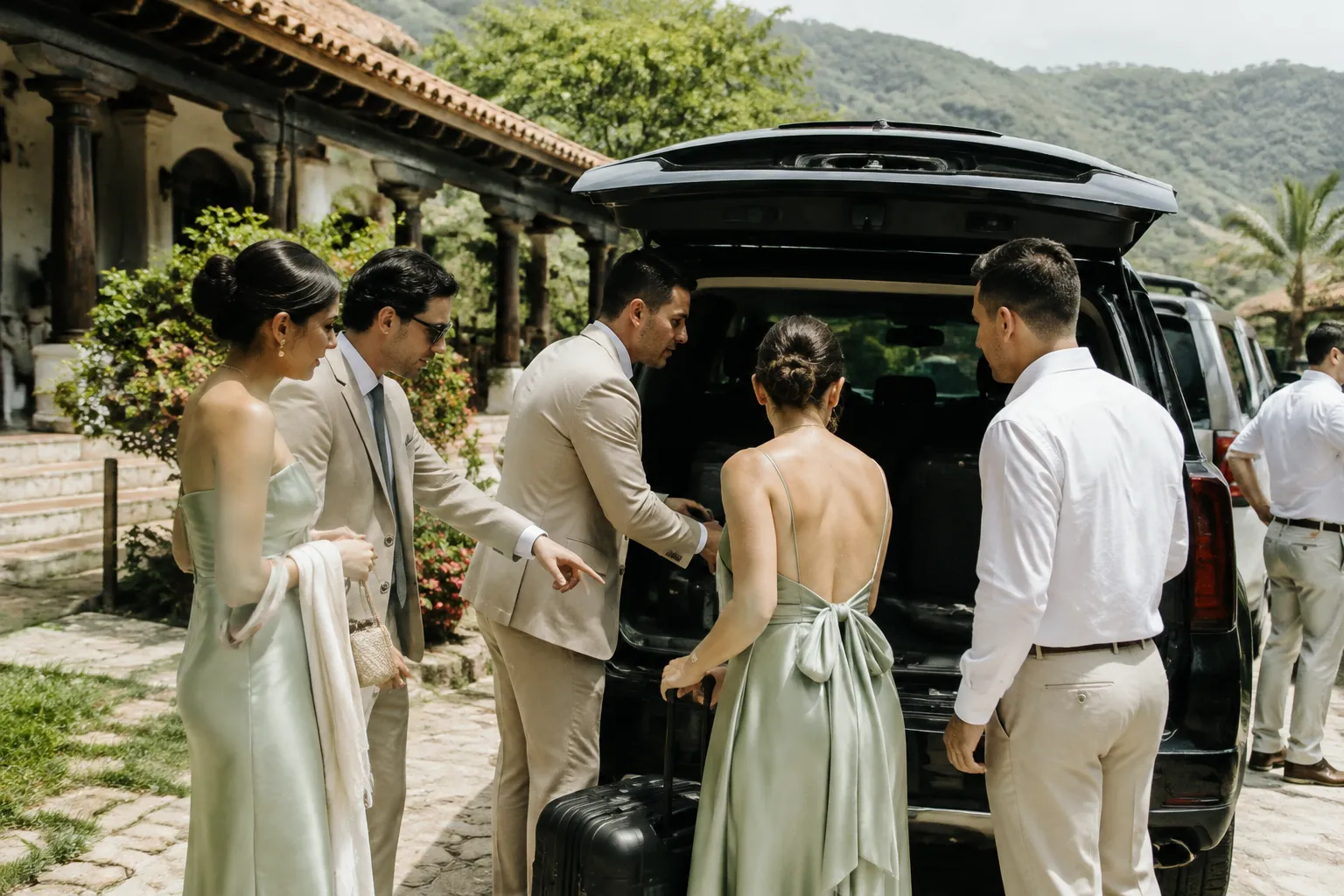
Ask the couple, planner, venue, or transport provider to confirm:
- The exact pickup location
- The pickup time and whether it is fixed
- The name or description of the vehicle
- The contact method for delays
- Whether guests should carry identification for venue access
- Whether the ceremony and reception use different entrances
- Whether luggage is permitted on the wedding transfer
- The return arrangement after the reception
- Whether guests can leave independently
Access questions become more important when the ceremony and reception are in different places, when the venue sits outside the main accommodation area, or when the family has arranged several wedding-related events across multiple days.
Do not assume that the person coordinating accommodation is also coordinating venue transport. Responsibilities vary by wedding, venue, provider, and planning arrangement. Ask who owns each detail.
Review Current Conditions Before Departure
Conditions can change between the invitation, the booking, and the travel date. Shortly before departure, review current information relevant to your actual itinerary:
- Entry and migration guidance
- Carrier notices and itinerary changes
- Regional travel information
- Weather or other conditions affecting the route
- Accommodation messages
- Transport-provider instructions
- Wedding schedule updates from the couple or planner
Colombia Travel Advisory is a country-level reference, not a venue-specific itinerary. Review the parts that relate to your route and seek current, region-specific context where needed. A broad advisory and a wedding-team update serve different purposes: one concerns travel information, while the other concerns the event's arrangements.
When the wedding team changes a pickup, accommodation, or venue arrangement, confirm that update directly with the person responsible. Do not assume that a general destination page or an older group message reflects the current plan.
Use a Simple Handoff Plan
A written handoff plan keeps responsibilities visible without turning the trip into a complicated project. Record the following in one place:
- Your arrival details
- Your accommodation details
- The venue address
- The transfer provider or group contact
- Pickup points and times
- The couple or planner's preferred contact method
- Carrier contact information
- Any accessibility or timing needs
- Your return route
- A response plan for a delayed arrival
| Travel stage | Primary confirmation point |
|---|---|
| Entry information | Migracion Colombia or the relevant authority |
| Flight and connection | Your carrier |
| Accommodation booking | Accommodation provider |
| Wedding pickup | Couple, planner, or transport provider |
| Venue access | Venue, couple, or planner |
| Regional travel conditions | Current government travel information and local itinerary contacts |
| Schedule changes | Couple or planner |
This plan does not settle current entry questions or guarantee that arrangements will remain unchanged. Its value is practical: it prevents an invitation, hotel booking, or general destination page from being treated as the answer to a question it was never meant to address.
Common Mix-Ups to Avoid
“The invitation confirms everything I need to enter.”
It confirms the event, not your individual entry process. Check current information for your nationality, travel document, itinerary, and transit points.
“The airport is close to the destination.”
A destination label may cover more than one arrival area or a venue outside the main city. Ask for the actual venue address and compare the full route.
“A hotel near the airport is automatically convenient.”
It may suit a short arrival stop, but the wedding schedule may call for accommodation closer to the venue or a group pickup point.
“The planner is handling every travel detail.”
The planner may coordinate some guest arrangements while the carrier, accommodation provider, venue, or transport provider controls others. Confirm the division of responsibility.
“A general travel advisory describes the wedding region precisely.”
Country-level information may not reflect the conditions of a particular region or itinerary. Review current regional information and ask the wedding contacts about schedule-specific changes.
“All guests can follow the same route.”
Guests may have different arrival dates, budgets, mobility needs, travel documents, and departure plans. Shared arrangements are useful only when they fit the people using them.
A Practical Final Review
Before departure, check that you can answer these questions:
- What is the full wedding venue address?
- Which source confirms my current entry details?
- Where do I arrive first?
- How do I reach the accommodation?
- How do I reach the venue?
- Who confirms the pickup point?
- What happens if my flight is delayed?
- Are the ceremony and reception in the same place?
- Which details should I confirm with the venue?
- Which details should I confirm with the carrier?
- What current regional information should I review?
- How will I return to my departure route?
If several answers are unclear, contact the couple or planner before finalizing the itinerary. Ask focused questions about the missing handoff instead of asking for a general description of the destination.
Final Planning Perspective
Destination wedding guest logistics works best when the journey is treated as a sequence: entry information, arrival route, regional transfer, accommodation, venue access, and return travel. Each stage has a different confirmation point, and the answer can change with the venue, timing, region, carrier, guest profile, and current conditions.
The couple or planner can explain the wedding itinerary. The venue can explain access. The transport provider can explain pickup arrangements. The accommodation provider can explain its own booking and arrival details. The carrier can explain the booked route. Relevant authorities can provide current information within their respective areas.
Your task as a guest is to connect those answers into one realistic route from home to the wedding venue, with enough clarity to know what is confirmed, what may change, and whom to ask next.
Sources
- Migracion Colombia for current entry-information confirmation routes.
- Colombia Travel Advisory for country-level travel information to review alongside the specific itinerary.
- Colombia Travel for general destination discovery and regional orientation.
- Safe and seamless travel and improved traveller experience for a general travel-stage and handoff framework.
- Destination wedding - popularity among young students for bounded contextual language about destination-wedding participation.