Colombian Catholic Wedding Roles and Participants
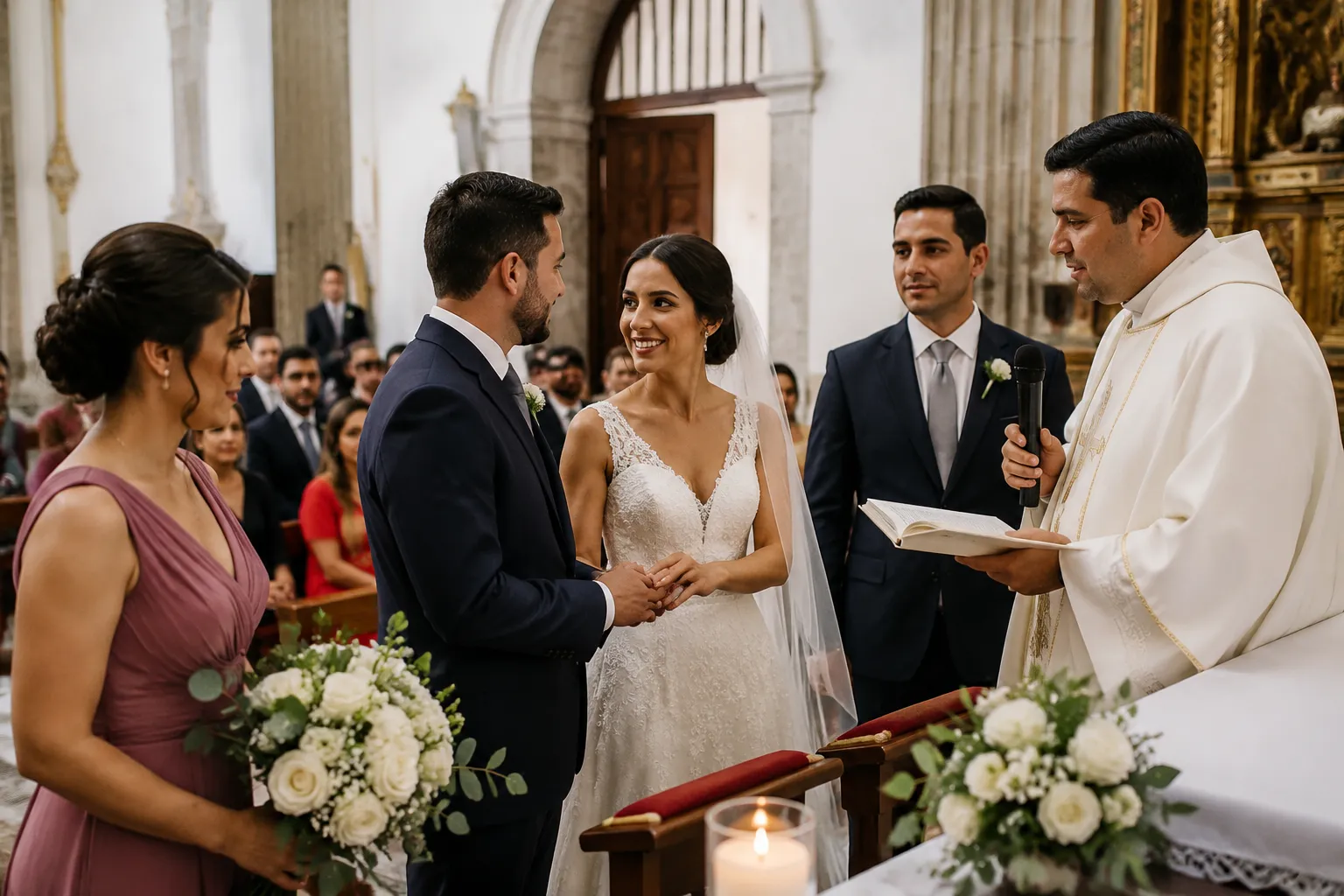
Choosing Catholic wedding sponsors becomes complicated when the couple, family, and parish use the same words for different responsibilities. In a Colombian or Colombian-diaspora wedding, padrino or madrina may describe a respected family connection, a symbolic participant, someone involved in the ceremony, or a person helping with a practical part of the celebration. Another family or parish may use different terminology altogether.
The useful question is not simply, “Who are the sponsors?” It is: What does the role mean for this couple, at this stage of the wedding, and within this parish?
General Catholic materials explain matrimony, liturgical participation, witnesses, and parish preparation, but they do not establish one Colombian sponsor model. Family custom and parish expectations should therefore be separated before anyone is invited, assigned a task, or promised a place in the ceremony.
What Catholic Wedding Sponsors May Mean
In planning conversations, “Catholic wedding sponsor” can refer to several kinds of involvement:
- A family or relational role connected with the couple
- Symbolic recognition during the wedding celebration
- Participation in a selected ceremony moment
- Practical support during preparation or reception planning
- Responsibility for an agreed item or expense
- A locally defined role discussed with the parish
These categories can overlap, but they are not interchangeable. A close relative is not necessarily a ceremony participant. Someone contributing money does not automatically hold a liturgical role. A person called a padrino by the family may not be the same person serving as a witness, reader, minister, or parish contact.
Who Participates, and Who Decides What?
The engaged couple remains at the center of marriage preparation and wedding planning. Other participants may be important, but each operates within a different part of the event.
| Participant | Possible connection | What to clarify |
|---|---|---|
| The couple | Chooses participants and coordinates the celebration | Which roles they want and which questions belong to the parish |
| Priest or parish representative | Guides parish preparation and ceremony planning | How this parish describes and accommodates each role |
| Witnesses | Take part in the public celebration of consent | How the parish identifies them and what information it requests |
| Padrino or madrina | May hold a family, symbolic, ceremonial, or practical role | Whether the title has family meaning, ceremony duties, or both |
| Parents and extended family | Support the couple and participate in family customs | Which traditions occur before, during, or after the liturgy |
| Readers, musicians, and other ministers | Assist with selected parts of the celebration | Who coordinates their participation with the parish |
| Planner or wedding coordinator | Manages schedules, vendors, guests, and reception flow | Which matters the planner can coordinate and which go to the parish |
This responsibility map prevents an important person from being given authority they do not hold. A parish representative can answer ceremony questions without managing the reception. A planner can build a timeline without determining liturgical decisions. A family member can be central to the couple without having a parish role.
What Changes From One Wedding to Another
The Family’s Use of Padrino and Madrina
Some families use these terms to express closeness, guidance, respect, or an ongoing relationship. Comparative research from other Catholic and Latin American settings shows that sponsor language can be connected with kinship, mentorship, family negotiation, and celebration organization. That context helps explain the social weight of the words, but it does not establish a single Colombian pattern.
Ask what the title means within this family, whether it refers to a particular wedding moment, and whether any expectations continue after the event.
The Parish’s Terminology
A parish may distinguish among witnesses, readers, ceremony participants, preparation contacts, and family titles. Do not assume that a familiar family term has the same meaning in parish planning.
Before announcing the role, ask whether the parish uses the word “sponsor,” how it understands padrino or madrina, whether the person may participate during the liturgy, and whether names or other details are requested in advance.
The Ceremony and Event Schedule
A wedding may involve a Catholic liturgy, a ceremony without Mass, a civil event on another day, family gatherings, and a separate reception. Participation can change at every stage. Someone involved in a family blessing or civil appointment may have no part in the church ceremony, while a ceremony participant may have no reception duties.
Keep separate participant lists for the Catholic ceremony, civil event, family gatherings, and reception until each responsibility is clear.
Location and Availability
Colombian-diaspora and destination weddings often involve relatives traveling between cities or countries. A person may be an excellent symbolic choice while being unavailable for meetings, rehearsals, or local coordination.
Confirm where the person lives, which events they can attend, how they will communicate with the couple or planner, and whether travel or time-zone differences affect the proposed task. Distance can change the practical role without reducing its emotional importance.
Four Dimensions of the Sponsor Role
Symbolic Participation
A sponsor may represent family support, continuity, affection, or respect. The person might be included in introductions, photographs, or family remarks without performing a defined action in the liturgy. Symbolic importance should not be confused with a parish expectation.
Ceremony Participation
A proposed sponsor may be invited to sit in a particular place, enter with other participants, present an item, or take part at a selected moment. Whether that can happen depends on the parish, priest, liturgical plan, and ceremony format.
Clarify where the person will sit or stand, whether they will speak or present anything, whether rehearsal is involved, and when the parish needs their name. Do this before printing programs or promising a visible ceremony role.
Practical and Administrative Support
A sponsor may help communicate with relatives, collect information, coordinate arrivals, or support the rehearsal plan. Those tasks do not make the person a parish decision-maker.
- The couple makes the wedding decisions that belong to them.
- The parish answers parish-specific ceremony questions.
- The planner coordinates schedules, vendors, and event logistics.
- A family participant can support communication or an agreed task.
Each person should know whether they are deciding, advising, coordinating, or simply helping.
Financial Participation
Some families may connect sponsor titles with paying for a particular item or part of the celebration. The available material does not establish a universal Colombian financial expectation.
If money is involved, discuss it separately from the invitation. Identify whether the contribution is a gift or an agreed expense, who selects the item or service, when payment is expected, and what happens if circumstances change. Financial support should not become an unspoken condition of family recognition.
Assign Responsibilities by Task, Not by Title
A title alone cannot tell the couple what someone has agreed to do. A responsibility map should name the task, the person coordinating it, and the person or organization that must confirm it.
| Planning area | Possible coordinator | Confirmation point |
|---|---|---|
| Parish questions | The couple | Priest or parish wedding contact |
| Ceremony schedule | Couple and parish contact | The specific parish |
| Family communication | Designated relative or planner | The couple |
| Readings and music | Couple and ceremony participants | Parish contact |
| Guest arrival | Planner or designated helper | Parish and venue |
| Reception contribution | Sponsor or family member | The people making the agreement |
| Photography participation | Couple and photographer | Parish restrictions and event timeline |
| Travel coordination | Couple, planner, or family contact | Each traveler involved |
A relative may coordinate family arrivals, but the parish determines how the church ceremony is organized. A sponsor may contribute to a reception element, but the venue controls what can happen in its space. A planner may draft the timeline, while the couple and parish settle the ceremony details.
When Sponsors May Participate
Before the Ceremony
This is the time to define the title, discuss family expectations, identify any practical contribution, and ask the parish how it understands the proposed role. Do not wait until the final week to discover that someone is expected at a meeting or rehearsal.
During Marriage Preparation
Catholic marriage preparation commonly centers on the engaged couple and may involve a priest or other parish participants. General Catholic sources do not establish a Colombian sponsor role within that process. Ask the specific parish whether sponsors attend any meeting, rehearsal, or wedding-day briefing.
During the Catholic Ceremony
The sponsor’s role may be visible, limited, or absent from the liturgy. Write the plan in plain language: who enters, sits, stands, speaks, presents anything, arrives early, and receives instructions from the parish.
During the Reception
Reception duties are separate from Catholic ceremony participation. Sponsors may appear in introductions, speeches, dances, photographs, or la hora loca, depending on the couple’s plan. Coordinate those details with the venue, planner, photographer, and entertainment team.
After the Wedding
Some families understand sponsorship as an ongoing relationship; others use the title mainly for the wedding. The couple should discuss whether they expect continuing advice, family visits, anniversary participation, or simply a meaningful presence at the celebration.
How to Choose the Right People
Begin With the Relationship
Choose someone whose connection to the couple fits the meaning of the invitation. This may be a relative, family friend, mentor, or another trusted person. The couple should be able to explain why the person is being invited and what the title means to them.
Separate the Honor From the Workload
If the role includes attendance, communication, coordination, or a contribution, check whether the person can realistically manage it. A relative living abroad may be a meaningful symbolic sponsor but a poor choice for local rehearsal coordination. One person does not need to carry every dimension of the role.
Consult the Right People Before Announcing the Role
- Ask the parish about ceremony participation and terminology.
- Ask the family about established customs and sensitivities.
- Ask the planner about timing, travel, vendors, and reception duties.
- Ask the proposed sponsor about availability, comfort, and expectations.
- Ask the venue about access, seating, and reception logistics.
Common Sponsor Misunderstandings
Padrino Always Means a Formal Catholic Role
It may be a family title, a ceremony label, or a locally understood role. Ask both the family and parish to define it for this wedding.
Wedding Sponsors Follow Baptism or Confirmation Godparent Criteria
Those are different sacramental contexts. Do not transfer expectations from one setting to another without asking the parish about the proposed wedding role.
A Sponsor Must Have a Particular Marital or Religious Status
The available sources do not establish a universal Colombian rule for every role described as a wedding sponsor. The relevant question is what the specific parish expects from the particular participant being proposed.
A Sponsor Must Pay for Part of the Wedding
Financial participation may be part of some family arrangements, but it should be discussed rather than assumed. Agree on the purpose, amount, timing, and voluntary nature of any contribution.
A Sponsor Controls Ceremony Decisions
A respected participant may influence family discussions without deciding the liturgical order. Family standing, planning responsibility, and parish responsibility are separate matters.
A Practical Coordination Route
- State the purpose. Complete the sentence, “We are inviting this person because…” Separate symbolic, relational, ceremonial, and practical reasons.
- Divide the wedding into stages. List family events, the Catholic ceremony, any separate civil event, and the reception.
- Confirm the terminology. Ask how the family and parish use words such as sponsor, padrino, madrina, and witness.
- Define participation. Record attendance, ceremony involvement, reception duties, speaking roles, rehearsal needs, travel, and the main contact person.
- Discuss money separately. Do not hide a financial request inside an honorific or family title.
- Reconfirm close to the event. Review arrival times, ceremony positions, reception cues, and any travel or scheduling changes.
A short written summary can prevent confusion. It should include the title being used, the purpose of the role, events the person will attend, agreed tasks, any separately discussed contribution, the main contact, and the date of final confirmation. This is a planning note for the people involved, not a parish document.
Questions That Resolve the Remaining Uncertainty
Ask the Parish
- Does the parish use a sponsor, padrino, or madrina category for this ceremony?
- Is that role different from the witnesses or other ceremony participants?
- May the person sit, stand, speak, read, or present anything during the liturgy?
- Does the parish request the person’s name or attendance at a rehearsal?
- Who should answer questions when family terminology differs from parish terminology?
Ask the Couple and Family
- What does the title mean in this family?
- Is it connected to a specific event or long-term relationship?
- What is the person expected to do?
- Is any contribution customary, optional, or already agreed?
- Are separate people involved in different parts of the celebration?
Ask the Planner or Venue
- Will the person be included in entrances, photographs, speeches, or dances?
- Does the venue need their name for seating or access?
- Who will cue them during the reception?
- Who handles last-minute schedule changes?
The Decision in One View
A coordinated sponsor plan answers five questions:
- Who is this person to the couple and family?
- What does the title mean in this wedding?
- Which event or stage includes the person?
- What task, if any, has been clearly agreed?
- Who must confirm the remaining details?
For a Colombian Catholic wedding, the sound planning approach is to preserve the family meaning of padrino and madrina without assuming a particular church status, ceremony duty, eligibility standard, or financial obligation. Once the relationship, task, event stage, and confirmation point are separated, the couple can honor important people without leaving their responsibilities undefined.