Colombian Wedding Attire
Colombian Wedding Attire
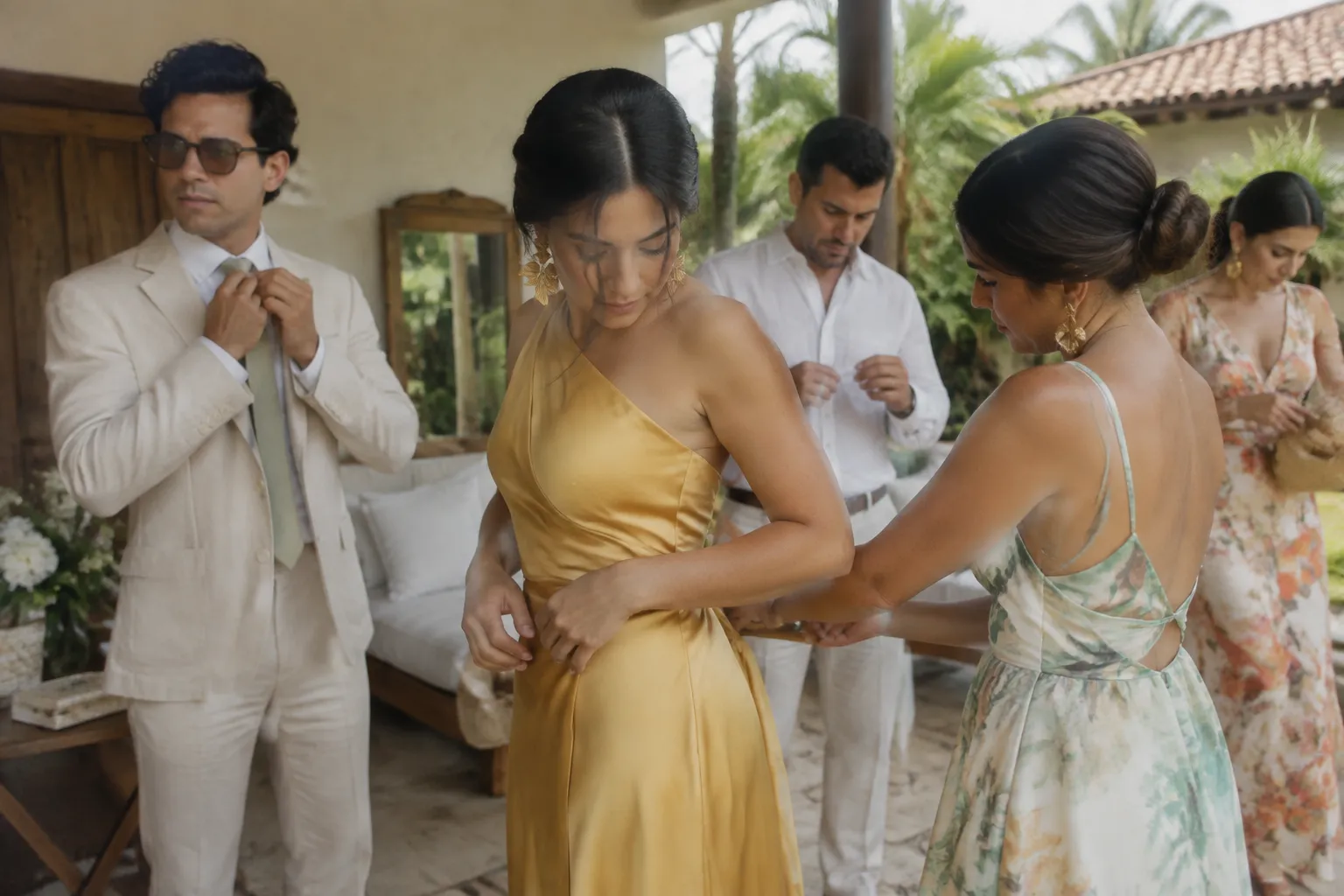
When choosing what to wear to a Colombian wedding, start with the specific invitation rather than a national rule. Check the stated dress code, the ceremony and reception settings, the city or region, the weather, the venue, and any instructions from the couple or planner. A wedding may be formal, semi-formal, religious, civil, indoors, outdoors, or a combination of settings, so the right outfit depends on the event in front of you.
A guayabera, linen suit, cocktail dress, full-length dress, suit, or light wrap may all work in the right context. None automatically fits every Colombian wedding. The invitation and the couple’s expectations should control the final decision.
More specific pages
These pages continue the topic in smaller, more specific directions.
How to Decide What to Wear
- Read the invitation wording. Look for terms such as semi-formal, cocktail, formal, black tie, black-tie optional, or a direct clothing request.
- Separate the ceremony from the reception. A church, civil venue, garden, beach, hotel ballroom, or mixed indoor-outdoor event may create different practical considerations.
- Check the location and conditions. Heat, humidity, rain, wind, air conditioning, sand, grass, gravel, stone, and uneven paths can affect fabric, layers, and footwear.
- Ask about unclear details. Confirm questions about white, coverage, sleeve length, floor length, ties, hats, themed clothing, or colors associated with the wedding party.
- Keep the whole look coordinated. Formality comes from the relationship between fit, construction, footwear, grooming, and accessories—not simply from using a light fabric or bright color.
If the invitation is vague, a short question is usually more useful than relying on photographs or generalized online advice:
“Could you clarify the dress code for the ceremony and reception? Should guests plan for formal, semi-formal, or a lighter outdoor look?”
Colombian Wedding Attire Is Not One National Uniform
Colombia has substantial regional, historical, and social variation in clothing. Traditional dress can reflect place, climate, festival, materials, history, and cultural setting. Terms such as pollera, cumbia pollera, ruana, sombrero vueltiao, and alpargatas belong to recognizable regional or traditional clothing vocabulary, but they should not be treated as default wedding guest attire.
A regional outfit may be relevant when the couple specifically requests traditional dress, creates a cultural theme, or includes a folkloric presentation. That is a separate choice from selecting contemporary clothes for an ordinary wedding invitation. Colombia’s clothing history also shows why a single national template can be misleading: dress has been connected with region, social position, identity, textiles, and changing cultural influences.
If an invitation uses phrases such as “Colombian style,” “Caribbean elegance,” or “traditional details,” ask what the wording means in practical terms. It may refer to color, fabric, accessories, regional dress, or simply the overall level of formality.
How to Read Wedding Dress Code Wording
Generic dress-code terms can help you interpret an invitation, but they do not replace the couple’s instructions. Time, place, ceremony type, and the movement between venues still matter.
| Invitation wording | Useful starting point | What to confirm |
|---|---|---|
| Semi-formal or cocktail | A polished dress, dressy separates, suit, or another coordinated look that is more finished than casual clothing. | Whether a daytime outdoor event calls for a lighter interpretation than an evening ballroom reception. |
| Formal | A refined presentation with an appropriate suit, full-length look, or similarly elevated combination. | Whether the couple expects traditional formalwear, a climate-adapted version, or a particular palette. |
| Black tie or black-tie optional | A higher level of formality than cocktail or semi-formal clothing. | Whether the couple has a specific warm-weather interpretation involving jackets, ties, fabric, or footwear. |
| Direct wording from the couple | Follow the stated request about light fabrics, no ties, long dresses, colorful eveningwear, or another detail. | Whether it applies to the ceremony, the reception, the wedding party, or all guests. |
A light fabric does not automatically make an outfit semi-formal, and a coastal or tropical setting does not automatically make formal clothing unnecessary. Fit, finish, structure, and coordination remain part of the decision.
Couple, Family, and Wedding Party Attire
The couple and wedding party may coordinate colors, fabrics, silhouettes, or accessories, but contemporary practices can vary considerably between regions, families, and events. Do not assume that a particular suit color, dress length, sleeve style, or accessory is a national convention.
If you are in the wedding party, ask about the details that ordinary guests may not need to know:
- whether clothing is supplied or selected individually;
- which colors, fabrics, or silhouettes are coordinated;
- whether the ceremony and reception use the same clothing;
- whether the venue creates footwear restrictions;
- whether a jacket, tie, wrap, or second layer is expected; and
- whether the outfit must work for outdoor photographs or movement between locations.
Family members may also have defined roles, with clothing coordinated through family preference or the couple’s plan. Guests should not imitate the wedding party without checking first, particularly when the invitation mentions a color palette or coordinated appearance.
For a custom request, ask for a written description rather than relying on an image alone. Clarify the level of formality, acceptable colors, coverage, fabric weight, and whether the request is cultural, practical, or purely aesthetic.
Church and Civil Ceremony Considerations
For a church ceremony, consider the setting and the couple’s expectations before choosing an outfit. Questions about shoulders, sleeves, knees, neckline, floor length, and hats are best handled as confirmation points rather than universal rules.
- Does the couple or parish have a stated clothing preference?
- Will the ceremony take place in a formal church, chapel, or another religious setting?
- Is the same outfit suitable for the reception?
- Should guests bring a wrap, jacket, or other layer?
- Are hats or other accessories discouraged for the ceremony?
- Will the ceremony and reception have different temperatures or surfaces?
A modest layer may be practical when the ceremony space is cool or when the couple has requested additional coverage. It should not be presented as a rule for every Colombian church wedding. Expectations can vary by parish, family, ceremony, and location, so confirm relevant details with the couple, planner, or parish.
The same principle applies to a civil ceremony: the ceremony format may affect the setting and schedule, but it does not create one national outfit rule. Let the invitation, venue, and couple’s instructions establish the level of formality.
Guayaberas, Linen, and Warm-Weather Clothing
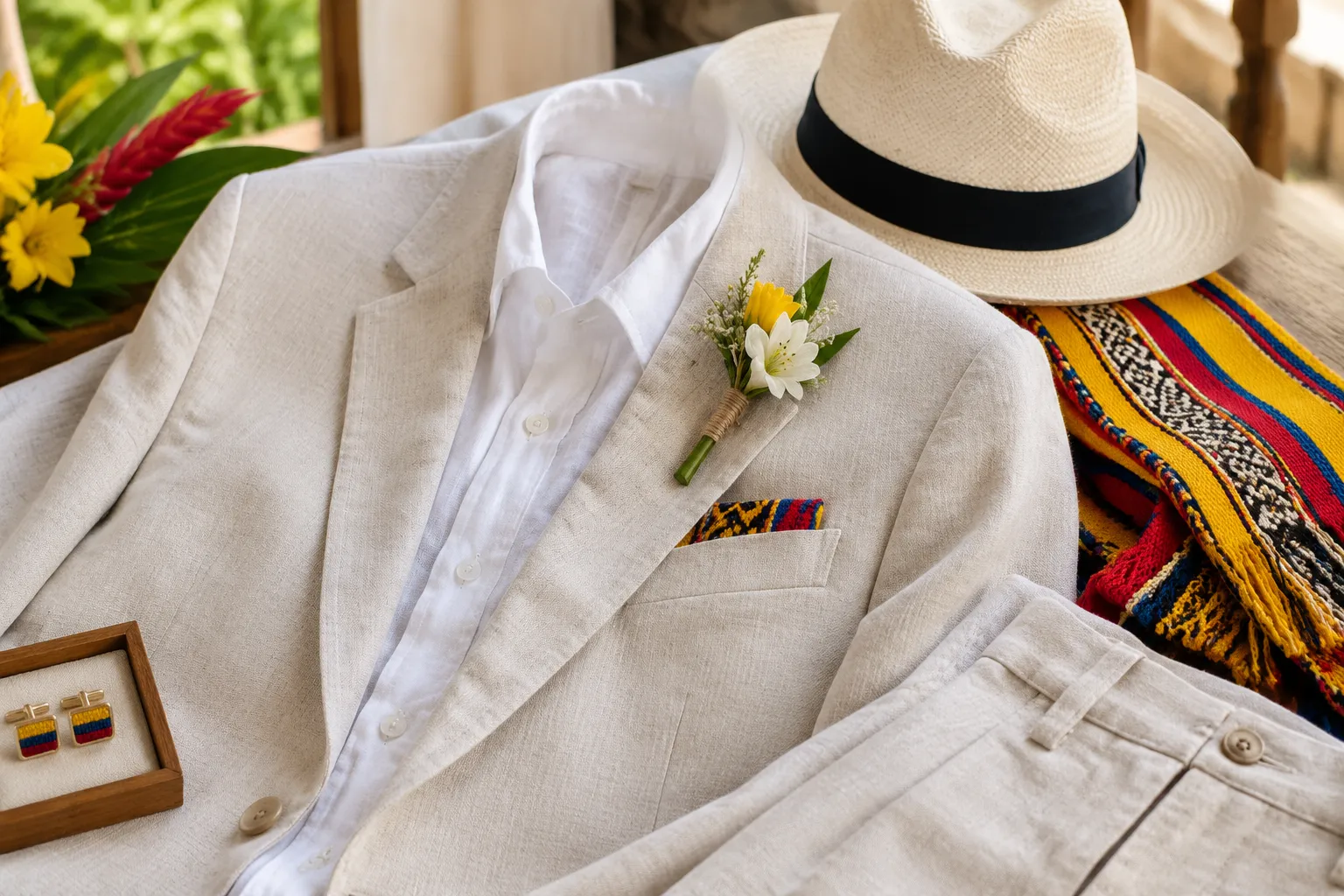
A guayabera may be offered as an option at some warm-weather or Caribbean weddings. One account of a Cartagena wedding describes a semi-formal event with guayaberas, light fabrics, linen or formal suits, optional ties, and several clothing options for women. That account illustrates how one couple communicated expectations; it does not establish a national dress code.
Before wearing a guayabera, check:
- whether the invitation mentions it;
- whether the dress code is semi-formal, formal, or black tie;
- whether the couple expects it with trousers, a jacket, a tie, or another layer;
- whether the ceremony is religious or held in a particularly formal venue; and
- whether the shirt should be tucked or styled in another specified way.
A white guayabera with trousers may suit one warm-weather event, but it is not an automatic substitute for formalwear. Linen can also be useful in warm weather while looking too relaxed for a particular ceremony or venue. Fit, pressing, footwear, and the rest of the outfit affect the result.
Hot Weather and Outdoor Wedding Attire
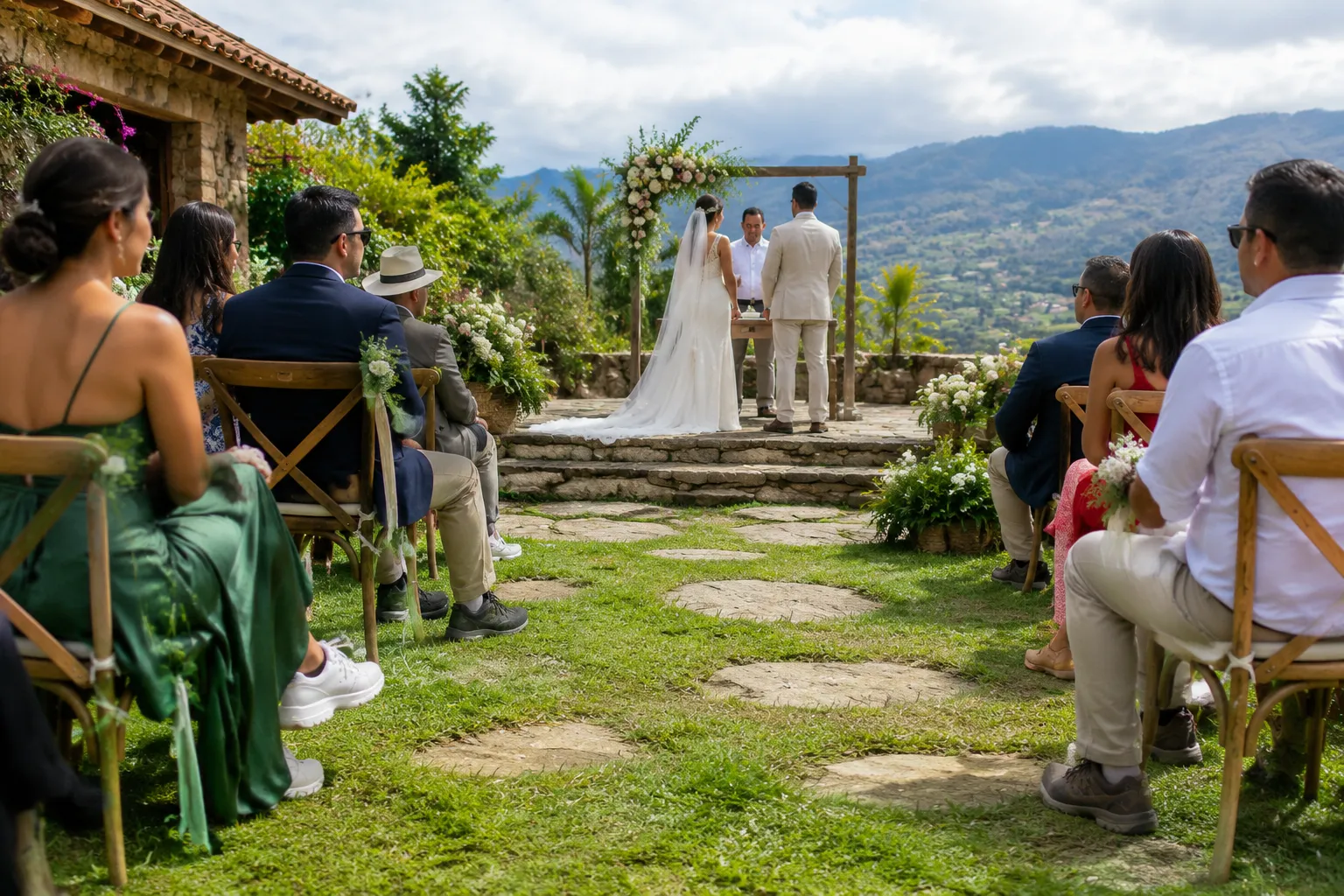
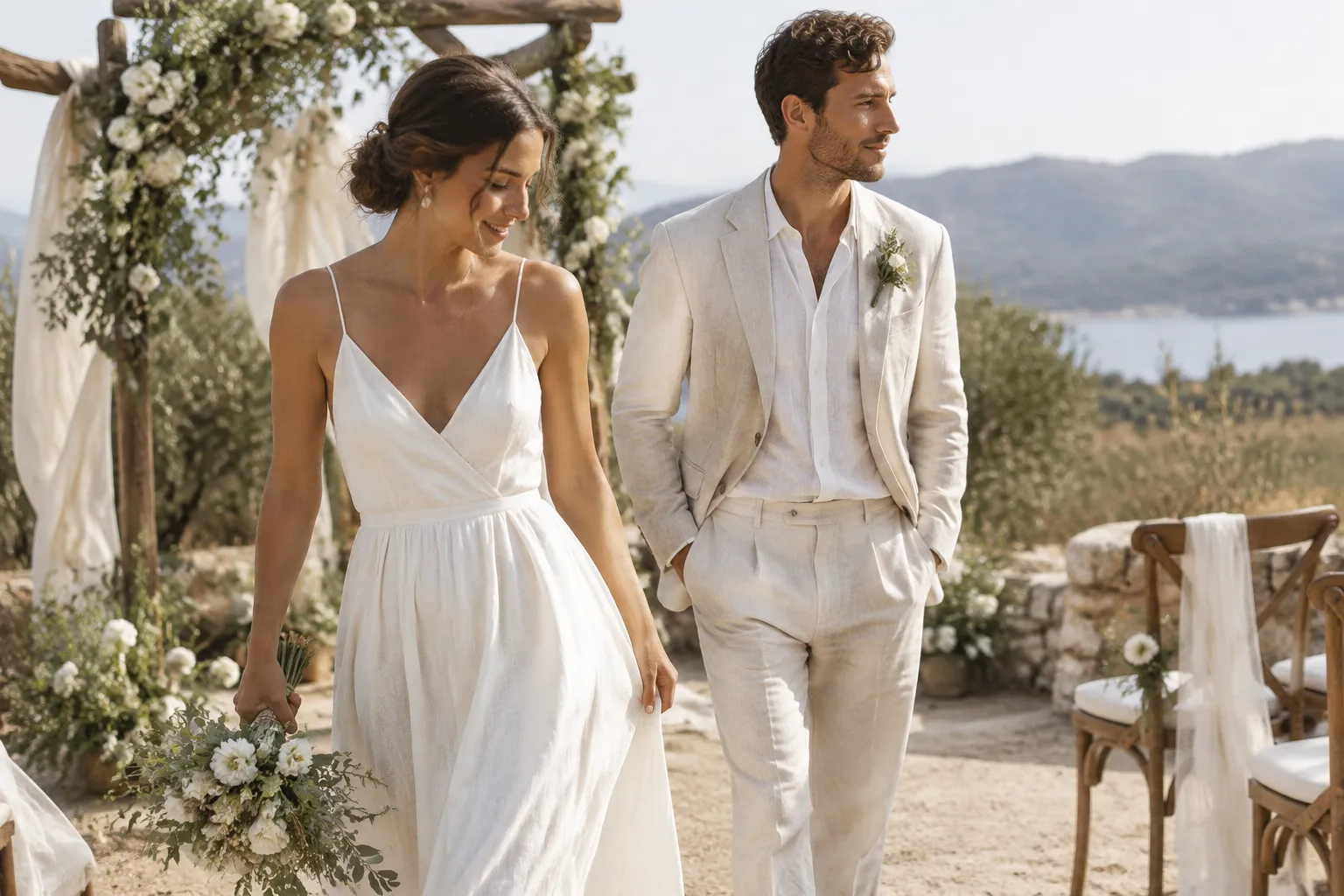
Climate should be treated as a venue question, not a national assumption. Cartagena, Bogotá, Medellín, highland locations, coastal venues, and other Colombian settings can differ substantially. Elevation, season, time of day, wind, rain, shade, humidity, air conditioning, and the forecast may all change what is practical.
| Venue or condition | Questions to consider |
|---|---|
| Heat or humidity | Can the fabric breathe while still matching the stated dress code? Will the construction remain polished? |
| Evening or indoor transition | Would a jacket, wrap, or light layer help with breeze or air conditioning? |
| Grass, sand, gravel, or stone | Will the footwear remain stable, and can the hem or trousers move comfortably across the surface? |
| Rain or uneven ground | Could a long hem, delicate shoe, or narrow heel become impractical? |
| Outdoor photography and dancing | Will the clothing allow movement without losing the intended level of formality? |
A beach, garden, terrace, or historic outdoor venue may require different footwear from a ballroom. A stable heel, formal flat, light dress shoe, or another practical option may be more useful than a narrow heel on grass or uneven ground. The choice should still remain consistent with the stated formality.
For a destination wedding, ask the venue or planner about actual surfaces and transitions. “Outdoor” may mean a paved terrace, lawn, beach, courtyard, or a ceremony followed by an indoor reception. Those details matter more than a generic tropical label.
White, Color, Coverage, and Presentation
Questions about white clothing, colors associated with the couple, sleeves, shoulders, neckline, floor length, and polished presentation appear frequently in wedding-attire discussions. The available material does not establish one national Colombian rule for these choices.
Ask the couple or planner:
- Should guests avoid white or near-white clothing?
- Are any colors reserved for the couple or wedding party?
- Is a particular color palette requested?
- Are sleeves, shoulders, knees, or neckline important for the ceremony?
- Is floor length expected, encouraged, or unnecessary?
- Are there cultural, religious, family, or venue-specific preferences?
A request for long sleeves, floor length, covered shoulders, a particular color, or a coordinated appearance may be specific to one couple, family, ceremony, or venue. It can still matter even when it is not a national custom.
Use Region as a Planning Clue, Not an Outfit Rule
Regional context can help you ask better questions, but city names alone cannot determine a current wedding outfit.
- Caribbean and coastal settings
- Breathable fabrics, lighter layers, and practical footwear may be useful. A guayabera may be mentioned, but the invitation still determines whether it fits the event.
- Bogotá and highland settings
- A jacket, wrap, closed shoe, or additional layer may be useful depending on the time, venue, season, and indoor temperature. Cooler weather does not make a formal event casual.
- Medellín and other locations
- Confirm the venue, time, ceremony type, forecast, surfaces, and couple’s instructions rather than transferring advice from another city.
- Regional or folkloric references
- Pollera, ruana, sombrero vueltiao, alpargatas, cumbia pollera, and other terms may relate to cultural programming or a specific request. They are not automatically ordinary guestwear.
A Simple Decision Map for Guests
Assign each unresolved question to the person most likely to know the answer.
| Question | Best confirmation point |
|---|---|
| What level of formality is expected? | Invitation, couple, or planner |
| Does the dress code apply to both ceremony and reception? | Couple or planner |
| Is a guayabera acceptable? | Couple or planner |
| Should guests avoid white or another color? | Couple |
| Is additional ceremony coverage requested? | Couple, planner, or parish where relevant |
| What footwear works at the venue? | Venue or planner |
| Will the event move between indoor and outdoor spaces? | Venue or planner |
| What weather and temperature should guests plan for? | Venue, planner, or a current local forecast |
| Is traditional or regional clothing requested? | Couple |
| Are wedding-party colors or silhouettes restricted? | Couple or wedding-party coordinator |
This separates cultural assumptions from decisions controlled by the event itself. It also prevents one photograph, retailer, hotel guide, or generic dress-code article from making the choice for you.
Common Mistakes to Avoid
- Treating Colombian attire as one fixed tradition. Regional and social variation means contemporary weddings do not follow one national uniform.
- Assuming a guayabera is always appropriate. It may work when the couple allows it, but it may not fit a formal, black-tie, church, civil, or venue-specific expectation.
- Applying Cartagena advice everywhere. Coastal clothing advice may not suit Bogotá, Medellín, highland venues, or another location.
- Confusing traditional costume with guest attire. Folk and regional clothing can be meaningful references without being expected wedding clothing.
- Turning one family request into a national custom. Coverage, colors, lengths, and accessories may be specific to one event.
- Choosing from a photograph alone. Social posts, retailer pages, hotel guides, and isolated wedding images show possibilities, not instructions for the wedding you are attending.
Questions to Ask Before You Pack
- What dress code should guests follow for the ceremony?
- Is the reception dress code the same?
- Is the ceremony in a church, civil venue, garden, beach, hotel, or mixed setting?
- Is a guayabera or linen outfit acceptable?
- Should guests avoid white, near-white, or wedding-party colors?
- Is additional coverage requested for the ceremony?
- Will guests walk on sand, grass, gravel, stone, or uneven paths?
- Should guests plan for heat, rain, wind, evening cooling, or strong indoor air conditioning?
- Is traditional or regional clothing part of the request, or should guests wear contemporary formalwear?
- Are there clothing expectations for family members or the wedding party that guests should know?
Frequently Asked Questions
What should I wear to a Colombian wedding?
Follow the invitation first, then adjust for the ceremony setting, venue, region, weather, and the couple’s instructions. A polished suit, dress, coordinated separates, guayabera, linen outfit, or another look may work depending on the stated formality.
Is a guayabera suitable for a Colombian wedding?
It may suit some warm-weather or Caribbean weddings when the couple permits it. It is not an automatic replacement for formalwear or for a specific ceremony or venue expectation.
Do I need a tie?
There is no single answer for all Colombian weddings. Some couples may describe ties as optional, while another event may expect them. Check the invitation or ask the couple, especially when the ceremony is formal or religious.
Should I wear white to a Colombian wedding?
Ask whether guests should avoid white or near-white clothing. Do not treat avoiding white as a universal Colombian rule, but follow a direct request from the couple.
What should I wear to a Colombian church wedding?
Choose clothing that follows the stated dress code and ask whether the couple or parish has a preference about shoulders, sleeves, knees, neckline, or other coverage. Bring a suitable layer when the ceremony and reception have different settings or temperatures.
Is linen too casual for a Colombian wedding?
Not necessarily. Linen can be useful in warm weather, but its suitability depends on the dress code, fit, construction, footwear, and overall presentation. It may suit one event and look too relaxed for another.
What is Colombian wedding attire by region?
There is no single regional chart that can determine a current wedding outfit. Coastal, highland, urban, rural, religious, civil, indoor, and outdoor events can differ. Use location as a prompt to check conditions, not as a substitute for the invitation.
Can I wear traditional Colombian clothing as a guest?
Only when the couple requests or clearly welcomes it. Traditional regional clothing is cultural context, not automatically the expected attire for contemporary wedding guests.
The Reliable Route
For Colombian wedding attire, the dependable route is simple: interpret the invitation, identify the ceremony and reception settings, check the venue and conditions, then confirm unclear details with the couple or planner.
Regional clothing history can explain why Colombia should not be reduced to one costume. Climate and venue details can guide practical choices about fabrics, layers, and shoes. A guayabera or linen outfit may work for the right event. None of these supporting clues outranks the actual instructions for the wedding you are attending.
The next questions are usually narrower: how to word a dress code, how to coordinate the couple and wedding party, and how to adapt clothing to the venue and weather.