Destination Wedding Timeline Planning
Destination Wedding Timeline Planning
A destination wedding timeline in Colombia works best as a set of connected schedules, not one fixed sequence of events. Guest travel, hosted celebrations, wedding-day production, and the civil or religious ceremony process move on different tracks. They need coordination, but they should not be treated as interchangeable.

Start with four questions:
- When do different groups need to arrive?
- Which events are essential, optional, or limited to the wedding party?
- What must vendors and family members do behind the scenes?
- Which ceremony details need local confirmation before the date is treated as settled?
This separation creates a flexible destination wedding timeline and prevents an early guest itinerary from being mistaken for a final operational schedule.
More specific pages
These pages continue the topic in smaller, more specific directions.
How to Build a Destination Wedding Weekend Schedule in Colombia
Build the schedule from the ceremony outward. The ceremony and reception form the central day, while arrivals, welcome events, optional activities, farewell gatherings, and departures sit around them.
Before assigning exact times, define the purpose of each day:
- Early arrival period: The couple, immediate family, wedding party, or anyone involved in preparation arrives.
- Main guest arrival period: Most guests check in and complete their ground transfer.
- Welcome period: Guests have a clear first gathering, usually after the main arrival window.
- Open or optional period: Guests rest, explore independently, or join a clearly labeled activity.
- Wedding day: The ceremony and reception run on a detailed production schedule.
- Farewell period: The couple hosts a final gathering when it fits the departure pattern.
- Departure period: Transport and check-out plans account for different flight windows.
These are planning categories rather than fixed Colombian customs. A couple may combine, remove, or reorder them according to the ceremony route, destination, venue access, guest profile, and transport conditions.
Map Dependencies Before Choosing a Format
A two-day, three-day, or four-day schedule is useful only after identifying the constraints that control it. Ask:
- Does the ceremony involve a civil process, a religious process, or separate civil and celebratory events?
- Does the wedding party need to attend a rehearsal or family gathering?
- Are guests arriving through direct flights or making connections?
- How long is the transfer from the arrival point to the accommodation?
- Are the ceremony and reception at the same venue?
- Does the venue have covered alternatives for exposed parts of the day?
- Are portraits planned before the ceremony, during cocktail hour, or at another time?
- Will immediate family or padrinos have defined ceremony responsibilities?
- Is an excursion central to the celebration, or merely an optional addition?
- Could holidays, festivals, school calendars, or local events affect accommodation and transport?
- Can guests depart the morning after the reception without missing a hosted event?
The answers determine how many event days are useful. The number of days should follow the logistics, not the other way around.
Keep the Guest Itinerary and Operational Schedule Separate
A shared guest itinerary and a detailed operational schedule serve different readers. Combining them often creates either too little information for the people running the event or too much detail for guests trying to understand the weekend.
The Shared Guest Itinerary
The guest-facing version tells people where they need to be, when they should arrive, how formal the event is, and whether attendance is expected or optional. It can include:
- Recommended arrival window
- Hotel check-in information
- Welcome event
- Optional excursion or free time
- Ceremony and reception
- Farewell event
- Main departure window
- Guest transport instructions
- Attire guidance for each hosted event
- A contact route for travel-day questions
An early version can remain broad. “Welcome gathering on Friday evening” may be enough before the venue and pickup time are settled. That gives guests useful travel information without presenting provisional details as final.
The Detailed Operational Schedule
The operational version is used by the couple, planner, venue, transport team, photographer, wedding party, musicians, and other suppliers. It may track:
- Venue access
- Deliveries and setup
- Hair, makeup, and dressing
- Family and wedding-party readiness
- Transport dispatch and passenger groups
- Ceremony preparation
- Guest seating
- Processional coordination
- Portrait windows
- Cocktail-hour coverage
- Reception entrances and speeches
- Meal service
- Music and dance transitions
- La hora loca, when included
- Supplier departure or collection
- Weather alternatives
- Late transport back to accommodations
Guests do not need most of this information. Operational details change more frequently than the main event structure, so sharing the production schedule too early can create confusion. Maintain one current version for each audience and assign someone to decide whether a change also affects the guest itinerary, wedding-party notes, transport sheet, or venue plan.
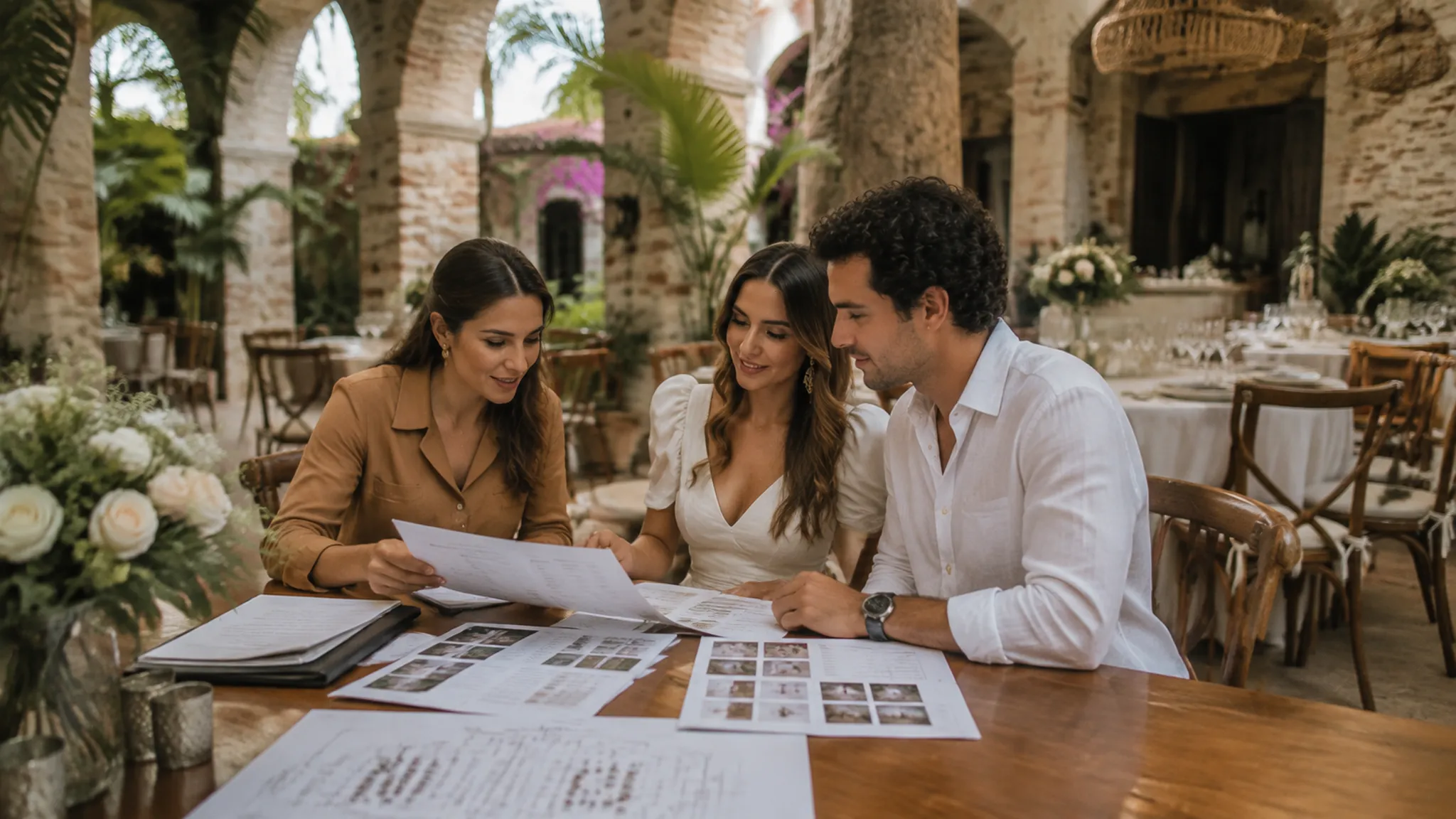
Decide Who Arrives Early
Destination wedding arrival timing should follow responsibility and travel conditions rather than one rule for everyone.
Early Guest Arrivals
People who may need an earlier arrival window include:
- The couple
- Immediate family with defined responsibilities
- Members of the wedding party
- Padrinos involved in planned ceremony moments
- Anyone attending a rehearsal
- Guests carrying essential personal items that would be difficult to replace
- Relatives who need more recovery time after travel
- People whose route involves multiple connections or a long ground transfer
An earlier arrival does not mean every person needs a hosted event on the first day. Quiet preparation time may be more useful than extending the formal program.
Main Guest Arrivals
For the broader guest list, work backward from the first event at which attendance matters. Consider flight schedules, connections, immigration and baggage time where relevant, hotel check-in, ground transport, mobility needs, and time to change clothes.
When a welcome event begins too close to the main arrival window, routine delays can turn it into a stressful deadline. The gathering might be informal, food could remain available over a wider period, or the first essential event could be scheduled later.
Not every guest needs to arrive one or two days before the wedding. Some routes call for a longer buffer, while others are straightforward and involve no pre-wedding obligations.
Departures Need the Same Analysis
A farewell event should fit actual departure windows. Brunch may work when many guests leave later in the day, but it may exclude those with early transfers. Alternatives include a casual drop-in breakfast, an evening farewell on the wedding night, or no additional hosted event.
The farewell event schedule should support the travel plan rather than pressure guests to change reasonable departure arrangements.
Compare Two-Day, Three-Day, and Four-Day Formats
These formats are planning options, not standard Colombian models.
| Format | Possible structure | Works when | Main pressure point |
|---|---|---|---|
| Two days | Arrival and welcome event; ceremony and reception | Travel routes are manageable and few people have additional obligations | Delays can affect the welcome event, and departures may begin soon after the reception |
| Three days | Arrival and welcome event; wedding day; farewell gathering and departures | The couple wants a clear arrival, celebration, and departure rhythm | The final event must fit varied flight and transfer times |
| Four days | Early arrivals or optional activity; main arrivals and welcome event; wedding day; farewell or recovery event | Guests have varied travel needs or the couple wants more unstructured time | More days increase communication, transport, and hosting complexity |
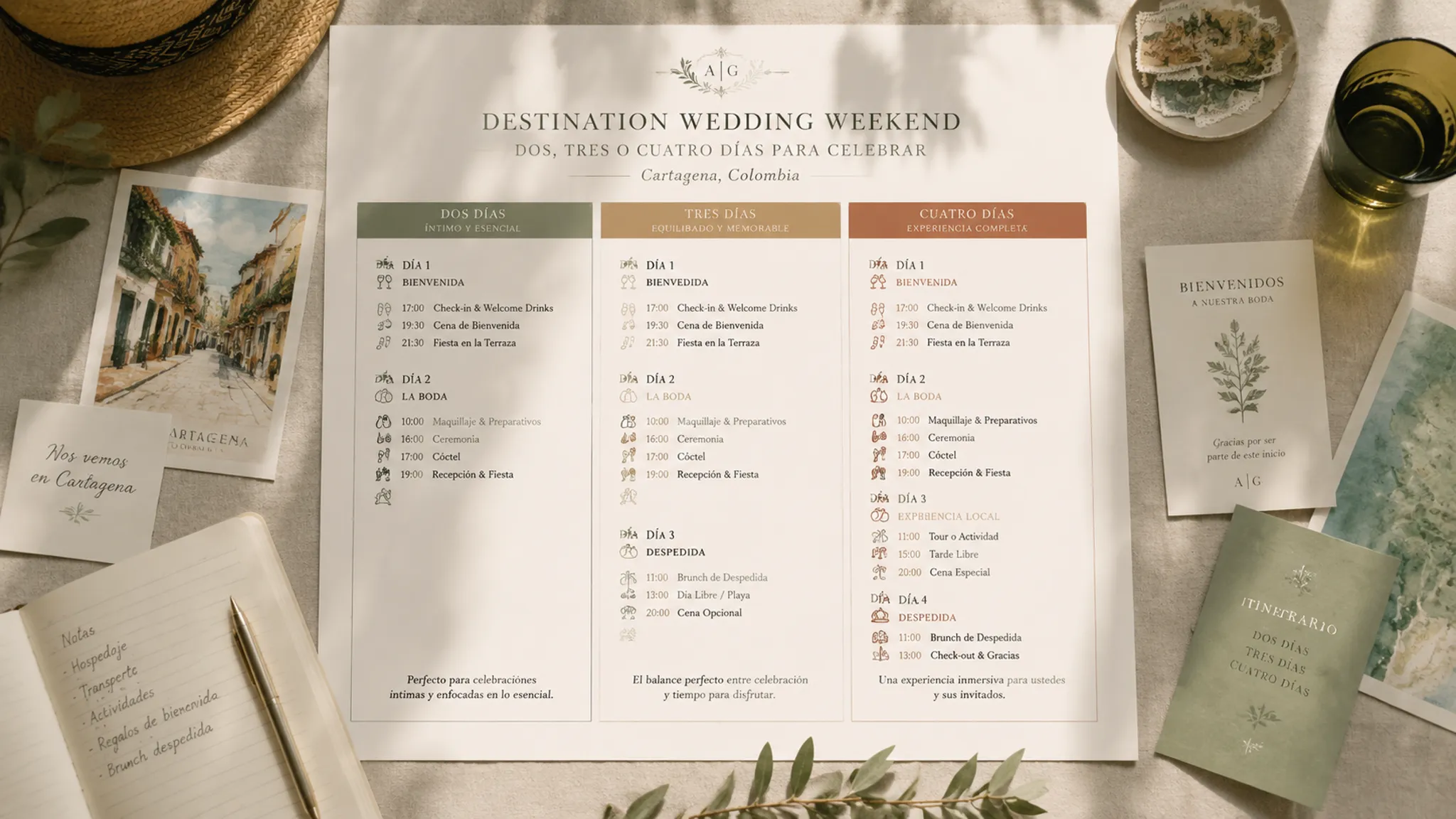
Two-Day Wedding Weekend Schedule
A compact structure might place main guest arrivals and the welcome event on the first day, followed by the ceremony and reception on the second.
Give particular attention to:
- How close the welcome event is to guest arrivals
- Whether the wedding party requires a rehearsal
- Whether anyone needs recovery time after a long journey
- When guests can depart after the reception
- Whether civil or religious arrangements occur separately
A two-day structure does not need to feel rushed if the first event is flexible and the wedding day does not contain unnecessary transfers.
Three-Day Wedding Weekend Schedule
A three-day format commonly provides one day for arrivals and a welcome event, one for the wedding, and one for a farewell gathering or departures.
Its main advantage is separation of functions. Guests can arrive before the central celebration, while the final day can absorb staggered departures. The couple still needs to decide whether the farewell gathering is a core event or simply convenient for those who remain.
Four-Day Wedding Weekend Schedule
A fourth day can accommodate early wedding-party arrivals, free time, or an optional excursion. It does not automatically make the weekend easier. Each additional activity creates questions about transport, meals, accessibility, cost responsibility, and guest expectations.
One external account from a couple marrying in Medellín described a four-day program that included a Guatapé excursion, a rehearsal brunch, and a welcome event. That single account shows one possible arrangement, not a Medellín- or Colombia-wide pattern.
Use a four-day structure when the additional day solves a real scheduling problem or reflects how the couple wants to spend time with guests. An excursion should not be added simply to fill the itinerary.
Build the Welcome Event Around Arrivals
A welcome event itinerary should help guests transition from travel into the celebration. It should not require everyone to arrive at the same minute.
First decide whether the event is:
- A formal hosted dinner
- A casual reception
- A drop-in gathering
- A wedding-party or family event
- An optional social event after check-in
A formal meal needs a firmer arrival deadline. A casual gathering can tolerate staggered arrivals. When many guests are traveling that day, the second format may reduce pressure.
Clarify the start and approximate end time, food service, attire, transport arrangements, attendance expectations, luggage arrangements, and the person to contact after a delayed arrival.
Keep rehearsals and wedding-party briefings separate unless all welcome-event guests are meant to attend. A rehearsal may involve only the people with roles in the ceremony.
Treat Excursions and Free Time as Separate Categories
Optional activities should be visibly different from essential wedding events. A guest should be able to decline an excursion without wondering whether they are missing part of the ceremony program.
An excursion may fit when:
- It does not compete with rehearsal obligations.
- The route and duration have been checked.
- Guests receive a clear description of mobility or clothing considerations.
- The return leaves enough recovery and preparation time.
- Transport includes contingency time.
- Essential people and items are not exposed to an avoidable late-arrival problem.
Free time can be a deliberate part of the destination wedding weekend schedule. Guests may need rest, independent meals, family time, or room to explore. Open space can make a multi-day plan easier to follow than one in which every hour is programmed.
Create the Ceremony and Reception Timeline
The guest-facing wedding-day schedule may contain only the ceremony time, transport instructions, reception information, and attire. Behind the scenes, the ceremony and reception timeline needs more detail.
Work Backward From Guest Seating
Start with the time guests should be seated, then account for transfer duration, vehicle loading, traffic or route uncertainty, venue entry, accessibility needs, ushers or family greetings, property-access procedures, and an operational buffer.
The invitation time is not a substitute for transport planning. When organized transport is provided, communicate pickup times and locations directly.
Place Preparation and Portraits Around Real Constraints
Preparation timing depends on the number of people involved, travel between locations, venue access, and the photography plan. Ask the photographer and venue to coordinate around the exact city, date, ceremony setting, and available light.
A commercial photographer’s record of one Cartagena wedding shows a possible sequence involving a late-afternoon ceremony, sunset portraits, and cocktail hour. It is an example of coordination, not a standard ceremony time. Sunset, heat, rain exposure, portrait duration, and venue layout need to be checked for the actual event.
When portraits take place during cocktail hour, decide which family groups are needed, where they will wait, how long the couple expects to be away, whether either person needs to join a reception transition, who signals that portraits must end, and what happens if the ceremony runs late.
Give the Reception Its Own Production Logic
A reception schedule may include entrances, speeches, dinner, first dances, family dances, live music, open dancing, food transitions, and la hora loca. Not every Colombian or Colombian-diaspora wedding uses the same order.
Confirm the intended flow with the couple, families, venue, planner, musicians, and master of ceremonies. Family expectations can affect who speaks, who enters with the couple, and when particular music or dance moments occur.
Avoid placing every reception segment at a rigid clock time too early. Some teams plan with target windows and clear triggers, such as beginning dinner after the couple is seated or starting la hora loca after a particular music set. The final method should match the venue’s service plan and the people managing the event.
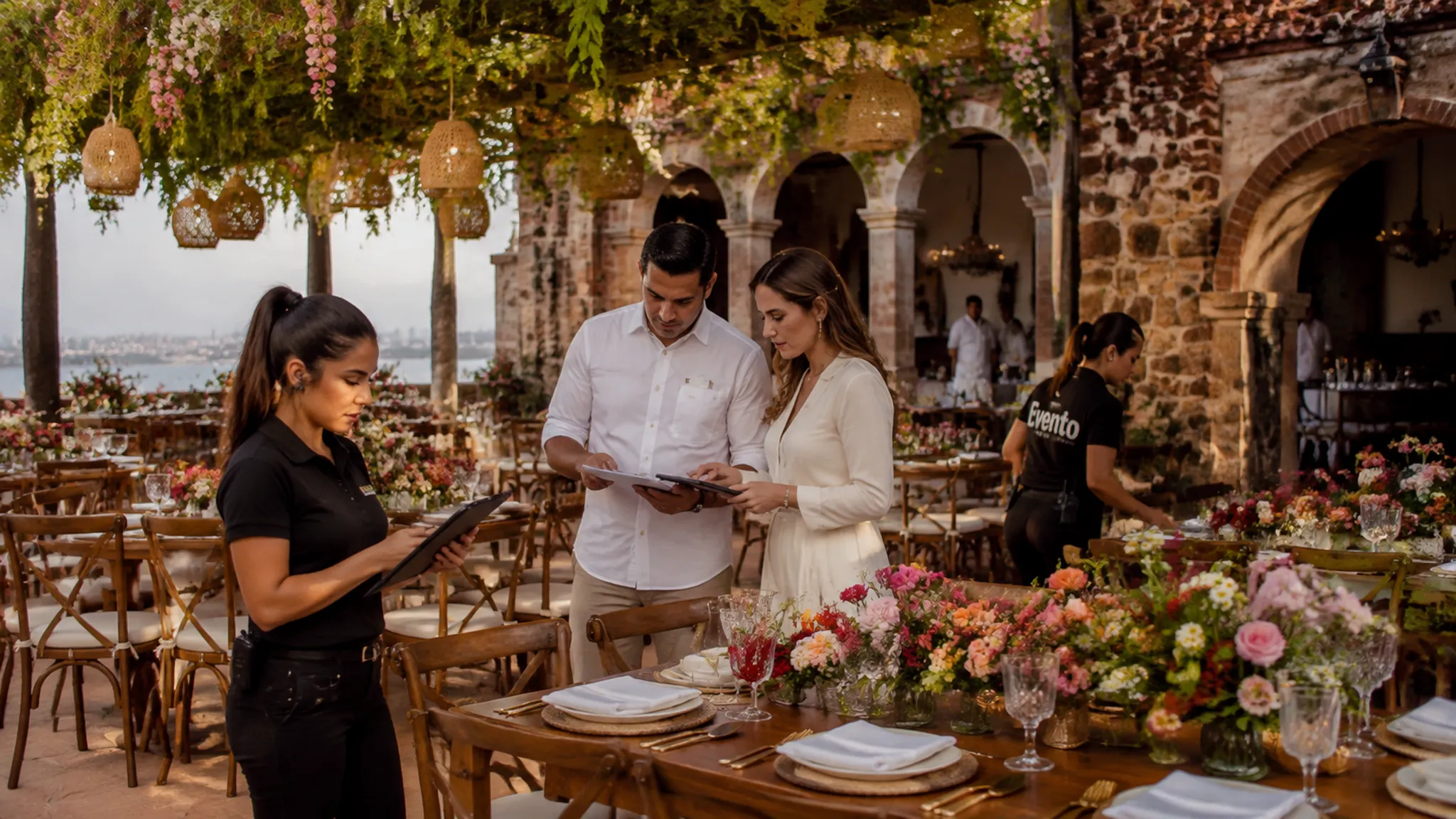
Add a Separate Civil or Religious Ceremony Branch
The Colombia wedding ceremony process should remain its own workstream. Do not bury it inside reception planning or assume that discussing a date with a venue settles every ceremony dependency.
For couples considering a civil or religious ceremony in Colombia, the first planning question is which route they are actually following. Some celebrations may involve separate civil and religious or symbolic dates. That difference can change when guests travel, which event is presented as the principal ceremony, and which local contacts need to be involved.
Civil Ceremony Planning Checkpoints
For a civil route, contact the selected Colombian notary or relevant civil office early. Foreign documents, Spanish-language translations, apostilles, review questions, corrections, or requests for additional material may affect the planning horizon.
Marriage in Colombia - U.S. Embassy in Colombia offers high-level orientation for U.S. citizens considering marriage in Colombia, including the role of a Colombian notary and the possibility that foreign documents may involve translation or apostille steps. It is not a complete document list and cannot establish what a specific office will accept.
Before treating a civil ceremony date as settled, ask the selected office or qualified professional handling the case:
- Which process applies to this couple?
- Which office will review the case?
- When can documents be submitted?
- Are translations or apostilles relevant to the documents involved?
- How will questions or corrections be communicated?
- At what point can the ceremony date be relied upon for the wider schedule?
- Does the civil event occur on the same day as the main celebration?
Do not build the timeline around a generic online checklist or a promised processing duration. Requirements and review questions can depend on the couple’s circumstances and the office handling the process. Confirm the route with the selected notary, civil office, planner, or qualified professional handling the specific wedding.
Catholic Ceremony Planning Checkpoints
For a Catholic ceremony, confirm the process with the specific Colombian parish or diocesan contact. Questions may include where preparation takes place, where the ceremony will be held, who coordinates paperwork, whether visiting clergy are involved, and when decisions about readings and music are made.
Examples from Catholic institutions outside Colombia may illustrate why early contact matters, but their schedules and procedures should not be transferred to a Colombian parish.
Keep the reception venue informed about dependencies that affect the date, while asking the parish directly about the ceremony process. Venue availability and parish availability are separate planning questions.
Check the Exact City and Dates
Colombia should not be treated as one uniform weather or travel setting. A countrywide season label cannot predict conditions for a particular city and wedding date.
The available material does not support a universal month, dry-period promise, or city ranking. Instead, add a local verification stage covering:
- Conditions commonly associated with the exact city and date
- Covered alternatives for outdoor events
- Heat and rain exposure
- Drainage and walking surfaces
- Transfer routes
- Sunset timing
- Local holidays and festivals
- School calendars
- Major local events
- Accommodation demand
- Venue access restrictions
Use current local or institutional information for these checks. A live weather observation for Bogotá, for example, does not describe another city or establish a seasonal pattern.
Ask the venue how weather changes are handled operationally. Determine who decides whether to move an event, when that decision must be made, how guests will be notified, and whether transport or photography plans also change.
Assign Ownership to Each Part of the Timeline
A schedule becomes more dependable when every decision has an owner.
| Timeline area | Primary conversation |
|---|---|
| Civil process | Selected notary, relevant civil office, or qualified professional handling the case |
| Catholic preparation and ceremony | Specific parish or diocesan contact |
| Venue access and weather alternative | Venue and planner |
| Guest arrivals and departures | Couple, planner, accommodation contact, and transport team |
| Wedding-party schedule | Couple, planner, and wedding party |
| Photography sequence | Photographer, couple, venue, and planner |
| Reception flow | Couple, families, planner, venue, musicians, and master of ceremonies |
| Guest communications | Couple or designated planning contact |
| Optional excursion | Activity provider, transport team, and planner |
| Family and padrino roles | Couple, relevant relatives, ceremony contact, and planner |
Ownership includes confirmation and communication. The person who receives a change from the venue may not be the same person who updates guests or redirects transport.
Use Decision Gates Instead of False Precision
A flexible schedule can still have firm checkpoints. Mark each item as:
- Exploring: The couple is comparing possibilities.
- Awaiting confirmation: A parish, civil office, venue, or supplier must respond.
- Provisional: The plan can be shared only as an outline.
- Confirmed for guests: Guests can rely on the date, location, and attendance expectation.
- Operationally final: The responsible teams have the timing and instructions needed to execute it.
This is especially useful when invitations, accommodation blocks, transport, or supplier commitments depend on the ceremony date. A date can be attractive and available without every ceremony dependency being resolved.
Set internal checkpoints for ceremony-route confirmation, venue and ceremony-date alignment, guest travel communication, accommodation planning, transport estimates, weather alternatives, photography sequencing, reception flow, the final guest itinerary, and the final supplier schedule.
There is no single planning lead time that fits every destination wedding in Colombia. Set checkpoints according to the destination, ceremony process, guest routes, and response times of the people involved.
A Practical Timeline Framework
The following structure can be adapted without turning it into a rigid template.
Planning Phase
- Identify the civil, religious, or separate ceremony routes under consideration.
- Contact the relevant local office, selected notary, parish, venue, or planner.
- Check the exact city and proposed dates for travel and calendar constraints.
- Map guest origins, flight connections, and ground transfers.
- Decide which groups need early arrival.
- Choose a two-day, three-day, or four-day event structure.
- Separate essential, optional, and wedding-party-only events.
- Hold uncertain details as provisional.
Guest Communication Phase
- Share the destination and dependable date window.
- Explain recommended arrival and departure considerations.
- Identify hosted and optional events.
- Provide accommodation and transport information as it becomes dependable.
- State attire expectations in practical terms.
- Update guests when provisional event times become confirmed.
Operational Phase
- Build the wedding-day production schedule.
- Coordinate venue access, setup, transport, preparation, photography, ceremony, and reception.
- Confirm family, wedding-party, and padrino responsibilities.
- Add weather and delay alternatives.
- Reconcile the transport sheet with the guest list and accommodation plan.
- Give each team only the version relevant to its work.
Final Confirmation Phase
- Recheck the ceremony route with the relevant local contact.
- Verify times and access details with the venue and suppliers.
- Check current local weather information and the operational weather decision.
- Confirm passenger groups and pickup locations.
- Resolve conflicts between the guest itinerary and operational schedule.
- Name the people who can make decisions during the wedding weekend.
Final Timeline Test
Before distributing the destination wedding timeline, read it from four perspectives.
- As a guest: Is it clear when attendance matters, what is optional, what to wear, and how to move between locations?
- As a family member or padrino: Are responsibilities and preparation times explicit?
- As a vendor: Are access, setup, transitions, transport, and decision owners defined?
- As the couple: Are civil, religious, venue, weather, or travel assumptions still being presented as settled facts?
A workable Colombia destination wedding timeline does not need to predict every disruption. It needs to keep unlike tasks separate, show where decisions depend on local confirmation, and give each person the information needed at the right stage. Once those layers are clear, the weekend can remain flexible without becoming vague.