Destination Wedding Weather and Venue Planning
Planning a destination wedding in Colombia involves more than choosing a preferred month or an attractive outdoor setting. The practical question is whether the weather patterns of the chosen region match what the venue can actually do when conditions change.
A coastal celebration, an Andean venue, an island wedding, and an interior reception may face different combinations of rainfall, temperature, wind, travel exposure, and guest movement. Historical climate information helps frame those differences, but it cannot predict a particular wedding day. The venue's covered or indoor capacity, the timing of the weather decision, and the communication plan may matter just as much as the destination comparison.
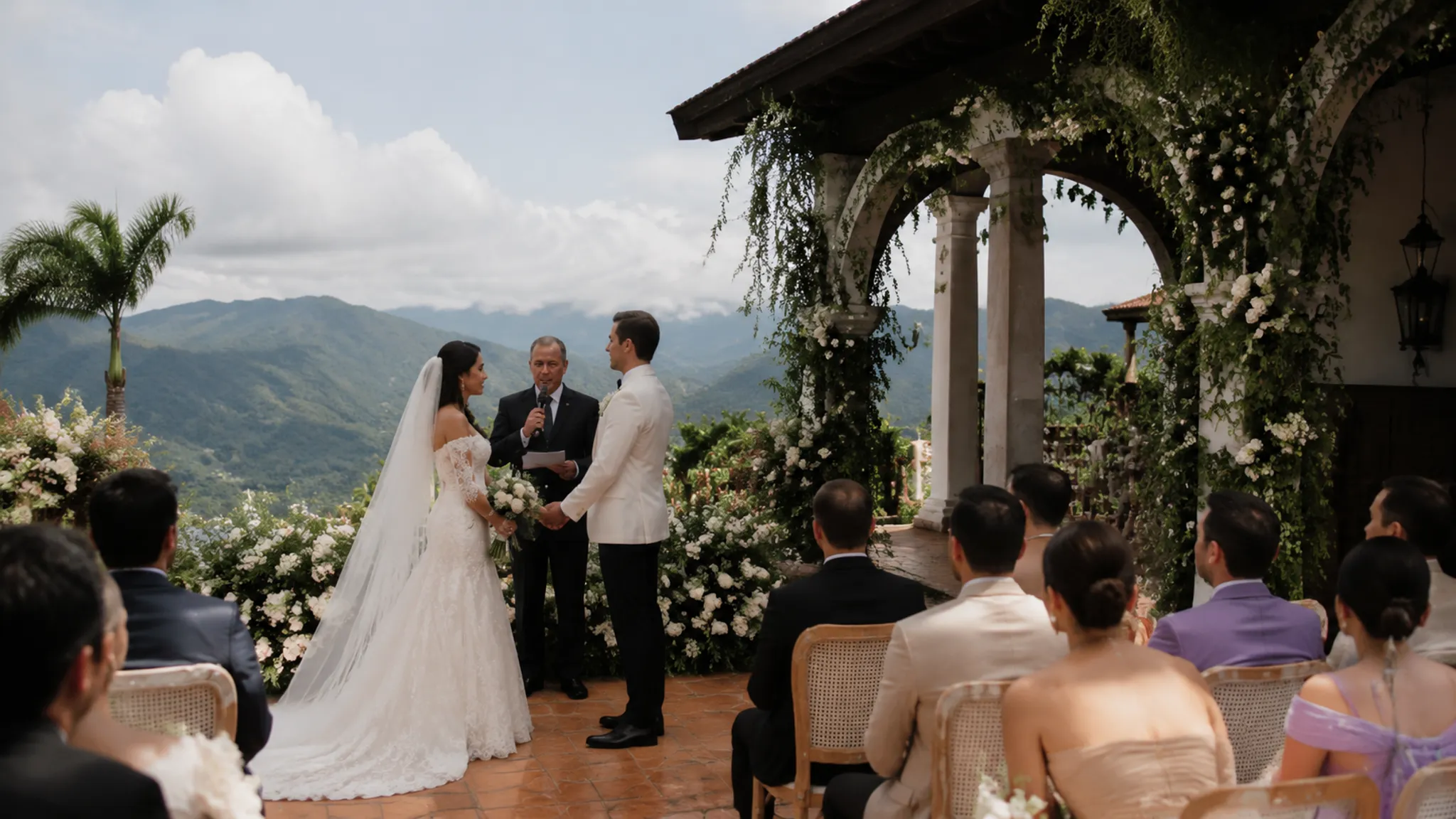
More specific pages
These pages continue the topic in smaller, more specific directions.
What Changes the Destination Wedding Weather Decision?
Four variables need to be considered together:
- the region and its local geography;
- the season and historical climate pattern;
- the venue's usable outdoor, covered, and indoor spaces;
- the timing and method for responding to changing conditions.
Colombia is not one uniform weather setting. Research on heavy and intense rainfall identifies different patterns across the Andean, Caribbean, Pacific, Amazon, and Orinoco regions. Rainfall indicators can also vary by season and between stations within the same broad area.
That makes a phrase such as “Colombia has a rainy season” too broad for a venue decision. A useful comparison starts with the specific municipality or destination, the nearest relevant weather stations, the reference period used by the climate product, and the units in which the information is presented.
The same caution applies to islands. Research covering San Andrés, Providencia, and Santa Catalina describes variation in historical rainfall and temperature behavior across a relatively small territory. An island should not be treated as one predictable weather space simply because it has one destination name.
How to Compare Colombian Regions and Timing
Begin with historical climate patterns, then move toward current conditions as the wedding approaches. Each type of information answers a different planning question.
Historical Climate Normals
Climate normals summarize historical observations across a defined period. Depending on the dataset, they may include rainfall days, total precipitation, mean temperature, or other measures.
For a destination wedding comparison, ask:
- Which station or stations are represented?
- What reference period was used?
- Are the results monthly, seasonal, or annual?
- Does the coverage reflect the venue's elevation and local geography?
- Are rainfall days and total precipitation being considered separately?
- Are the units clear?
Rainfall days do not describe the same thing as total precipitation. One destination may have several days with brief showers, while another may have fewer rainy days but more intense events when rain occurs. The duration and timing of a shower can matter more to a ceremony than the monthly total alone.
IDEAM climate resources can provide a starting point for this historical context. Use them to understand broad regional patterns and to identify details that still need local interpretation. Historical normals can inform a timing discussion; they do not establish a dry wedding date or a universally superior month.
Regional Weather Uncertainty
Colombia-specific rainfall research shows why averages need careful handling. A study of rainfall from 1981 to 2018 found changing patterns in heavy and intense rainfall indicators across different regions and seasons. A separate study of Magdalena from 2000 to 2022 found variation in temperature, precipitation, and solar radiation, with ENSO-related periods influencing conditions in some years.
These findings help describe variability, but they do not produce a forecast for one wedding date. Historical information frames the range of conditions a destination has experienced. It does not tell the couple what will happen on a particular Saturday.
Destination Comparisons
Compare destinations by the type of uncertainty the event can handle, rather than by a simple dry-versus-rainy label.
| Planning question | Why it matters |
|---|---|
| How exposed is the ceremony site? | Lawns, beaches, terraces, and mountain settings may respond differently to rain, wind, heat, or lightning. |
| Is there a nearby covered or indoor space? | A backup is more useful when guests can reach it without a complicated transfer. |
| Can the reception remain in place? | Moving only the ceremony may be easier than relocating dining, dancing, sound, and decor. |
| How do guests arrive and move? | Rain can affect walkways, transport, clothing, photography, and access for guests with different mobility needs. |
| What equipment is exposed? | Sound, lighting, furniture, catering, flowers, and personal belongings may need protection or relocation. |
| Who coordinates the response? | A defined decision-maker helps prevent delays and contradictory messages. |
| What local information is available? | Near-term decisions depend on relevant observations and forecasts, not on a general destination page. |
A destination with an attractive historical profile may still be difficult if its backup area is distant, already booked, too small, or excluded from the agreed arrangement. The venue's operating plan belongs in the comparison from the beginning.
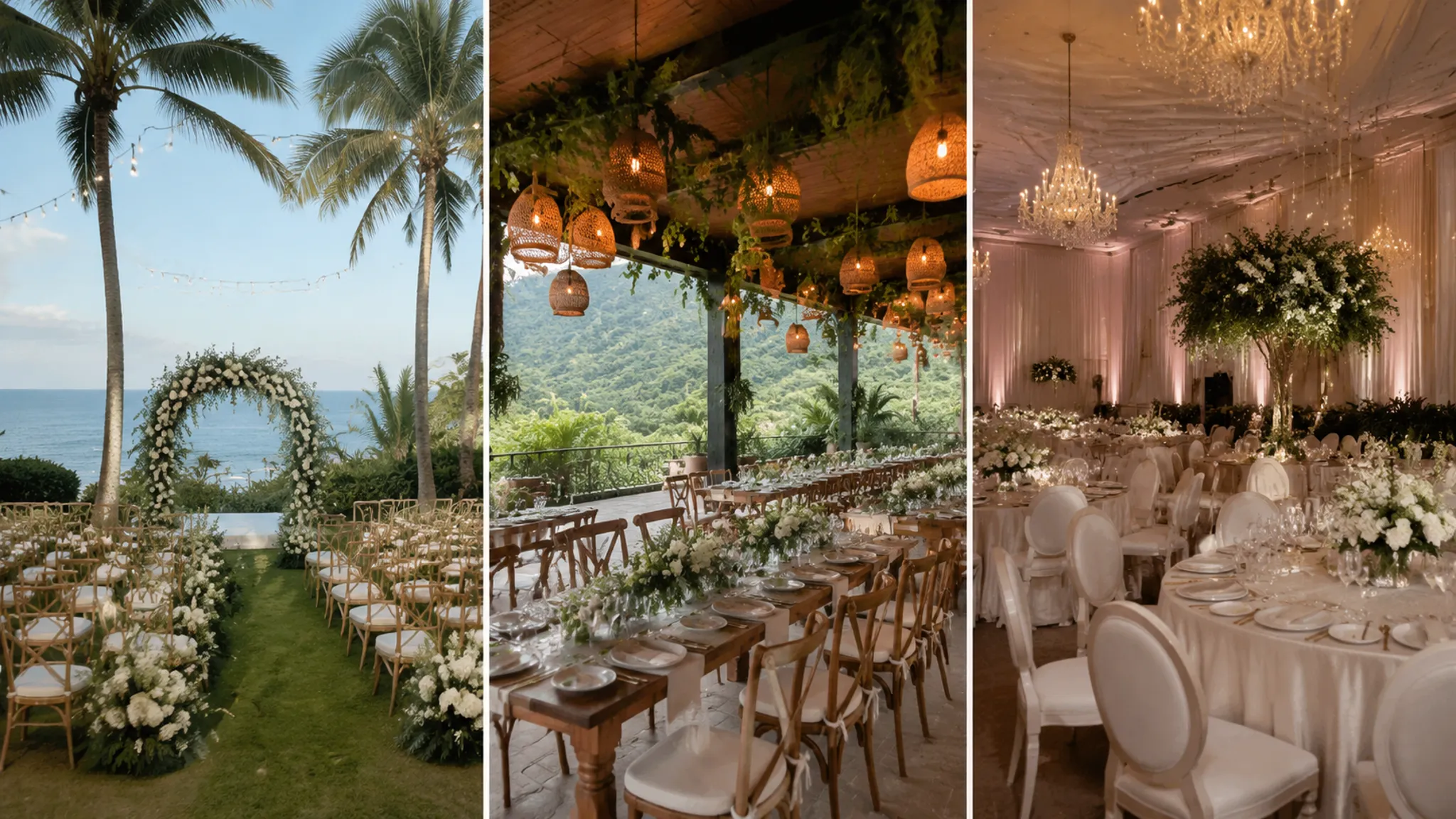
Outdoor, Covered, and Indoor Venues Are Different Formats
“Outdoor-friendly” does not describe a complete weather contingency by itself. Ask the venue to explain what each space can support and how the event changes when the original plan is interrupted.
Outdoor Ceremony and Reception
An outdoor format may be central to the couple's vision because of its landscape, natural light, or open-air atmosphere. Some couples experience that format as more romantic or natural, while an indoor arrangement may feel more predictable. That is a preference tradeoff, not a conclusion about weather or event safety.
Assess the outdoor plan for:
- exposure to rain, wind, heat, and lightning;
- shade and protection for guests;
- the condition of paths and surfaces after rain;
- access to restrooms and indoor shelter;
- protection for sound and lighting equipment;
- catering movement and food-service continuity;
- a practical route for moving guests;
- a photography plan if the original setting is unavailable.
A morning ceremony may suit the couple's schedule, but it does not remove weather uncertainty. Time of day should support the contingency plan rather than stand in for one.
Covered Backup Space
A covered space may be a permanent structure, terrace, pavilion, or tented arrangement. Its usefulness depends on whether it is available, suitable, and ready for the event format.
Confirm:
- whether the space is reserved for the wedding date;
- whether it holds the expected number of guests;
- whether both ceremony and reception layouts fit;
- whether side protection is available if rain is blowing in;
- whether flooring, anchoring, lighting, fans, or heaters are needed;
- whether power and sound equipment can be used there;
- how guests reach the space;
- how quickly it can be prepared;
- which costs are included and which are additional.
A tent is not a single solution. Sidewalls, anchoring, flooring, drainage, setup time, transport, lighting, and temperature management may all affect whether it works for the site and the event layout. The venue or planner should describe the actual arrangement rather than rely on a general statement that a tent can be added.
Indoor Wedding Space
An indoor space may provide more predictable shelter and simpler equipment protection, but it still needs review. Check its capacity, ventilation, temperature management, sound limits, dining layout, dance area, guest access, and relationship to the ceremony site.
If the room is also used for another event or activity, confirm when it becomes available and who controls the transition. A backup room shown on a floor plan but unavailable during the changeover is not an executable plan.
Build an Outdoor Destination Wedding Rain Backup Plan
A workable backup plan should identify actions, people, timing, and consequences.
1. Define the Decision Points
Ask when the first weather review occurs and when the final call is made. The answer may depend on the venue, planner, suppliers, travel conditions, and the type of weather being monitored.
The plan should distinguish between:
- monitoring conditions before guests arrive;
- adjusting the ceremony location;
- pausing an outdoor activity;
- moving guests under cover;
- protecting equipment and decor;
- changing photography routes;
- altering transport or arrival timing;
- continuing the reception in a modified format.
A forecast percentage does not automatically determine the response. The useful question is how the venue and planner translate changing information into a specific action for this site.
2. Assign Responsibility
Name the person who monitors weather information, the person who makes the call, and the people who communicate it.
The roles may involve the couple, planner, venue team, transportation coordinator, photographer, caterer, and sound provider. The arrangement can vary, but it should be agreed in advance.
- Who checks current conditions and short-range forecasts?
- Who decides whether to pause or relocate an outdoor activity?
- How much notice do suppliers need?
- Who tells the couple and family members?
- Who updates guests?
- Who protects equipment?
- Who coordinates the venue transition?
Event-weather operations examples from outside Colombia can help couples formulate these questions around staffing, audience movement, equipment, and timing. They do not establish a Colombian wedding procedure or a universal threshold.
3. Protect Guest Movement
Guest comfort is part of venue planning, especially when people have travelled for the celebration. Consider movement from vehicles to the ceremony, from the ceremony to the reception, and between indoor and outdoor areas.
Ask the venue and planner:
- Are covered walkways available?
- Where can guests wait during a changeover?
- Are umbrellas available, and who distributes them?
- Is there a place for wet coats, bags, or shoes?
- Can older guests, children, and guests with mobility needs move between spaces?
- Will updates be sent by message, delivered by staff, or both?
- Does transportation need to be rescheduled?
- How will signage change if the original route is closed?
Guest movement should be part of the weather response, not an afterthought added once the ceremony location has changed.
4. Rework the Event Layout
A weather change can affect more than the ceremony. Discuss what happens to:
- the altar or ceremony backdrop;
- floral arrangements and personal decor;
- dining tables and bar service;
- catering preparation and food transport;
- music, microphones, speakers, and lighting;
- the dance floor;
- photography locations;
- cake delivery and display;
- transportation staging;
- family portraits and group photographs.
A flexible timeline may allow the couple to delay an outdoor segment, take photographs in a sheltered location, or move directly into the reception. Flexibility only works when the venue and suppliers have agreed how the transition will be handled.
Separate Forecast Information From Venue Decisions
Climate Normals
These describe historical patterns across a defined dataset. They help with early destination and timing comparisons.
Current Observations
These describe conditions at a particular observation point. They may not represent the venue, especially where elevation, coastline, terrain, or distance changes local exposure.
Short-Range Forecasts
These support nearer-term planning. They can help the team decide when to review the plan, contact suppliers, adjust guest messages, or prepare shelter. They do not determine the outcome of the wedding.
Projections
Long-range climate projections describe possible future conditions under stated scenarios. They may inform longer-horizon destination planning, but they should not be treated as a precise forecast for an individual wedding date.
Check which product is being used and what geographic area it represents. A weather portal may contain observations, forecasts, warnings, historical information, and preparedness material in separate sections, and those products should not be treated as interchangeable.
Keep a Clear Outdoor-Weather Safety Boundary
An outdoor plan should account for rain, lightning, wind, heat, guest movement, equipment, and communication. The response for a particular location should be confirmed with the venue, planner, local weather service, and relevant emergency authority.
General lightning guidance from the United States National Weather Service can illustrate why an outdoor event needs a defined response when lightning is present. It is background guidance for planning questions, not Colombian law, a local venue procedure, or a Colombian threshold.
Ask:
- What information triggers a pause or relocation?
- Where do guests go?
- How is the decision communicated?
- How are staff and suppliers positioned?
- What happens to outdoor equipment?
- When can the activity resume, if appropriate?
- Who records and communicates the final decision?
Keep the plan operational. It should state what people do, where they go, and who tells them.
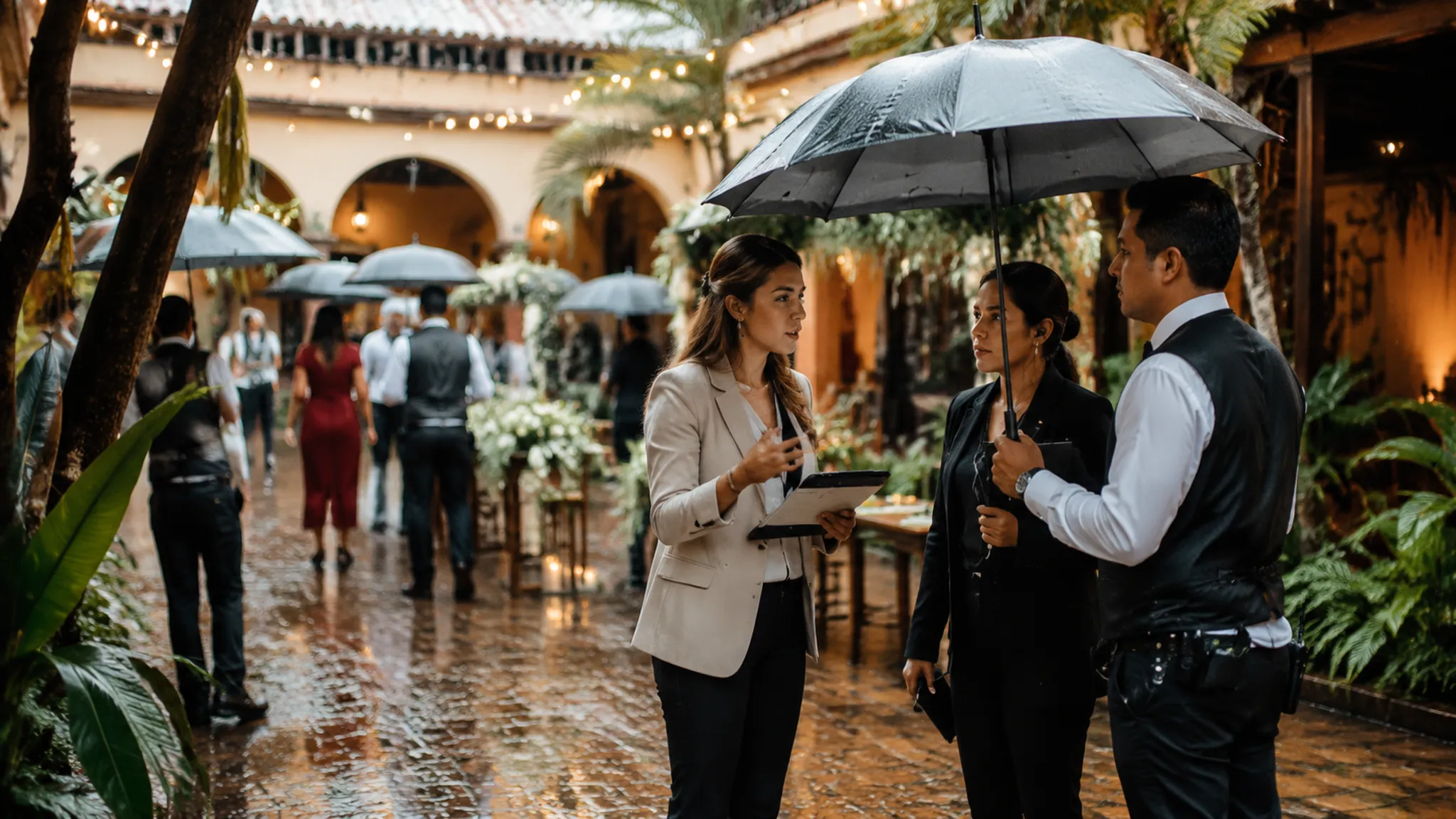
Compare Total Cost, Not Only the Venue Fee
Outdoor and indoor venues can create different cost structures. A lower outdoor base fee does not establish a lower total event cost once contingency arrangements are included.
Ask whether the quoted arrangement includes or excludes:
- tent rental, sidewalls, anchoring systems, and flooring;
- transport, setup, removal, and additional staffing;
- lighting, fans, heaters, and umbrellas;
- drying areas and furniture relocation;
- sound and power adjustments;
- catering, decor, and photography changes;
- guest transportation changes.
Request the weather-contingency terms in writing and match them to the actual event layout. A backup requiring last-minute rentals, additional labor, or a separate transport plan should be evaluated before the venue is selected.
A Practical Confirmation Route
- Identify the location precisely. Record the municipality, venue setting, elevation or coastal exposure where relevant, and the nearest useful climate information.
- Review historical patterns. Use an IDEAM climate product or another suitable Colombian source, checking the station, period, variables, units, and geographic coverage.
- Describe the preferred format. Decide whether the ceremony, reception, photographs, and dancing are intended to be outdoors, covered, indoors, or divided between spaces.
- Test the backup physically. Ask to see the proposed space and understand its capacity, route, layout, preparation time, and equipment needs.
- Map responsibilities. Confirm who monitors conditions, makes the weather call, contacts suppliers, and updates guests.
- Price the full response. Include rentals, staffing, setup, transport, equipment protection, catering, decor, photography, and guest movement.
- Set the near-event review process. Confirm which current observations and short-range forecasts will be checked and when the plan will be reviewed.
- Keep ceremony-specific questions separate. If a civil office, parish, celebrant, or other local authority is involved, confirm those questions directly with that party. Venue weather planning does not answer ceremony requirements.
Common Questions About Destination Wedding Weather
Is There One Best Month for a Destination Wedding in Colombia?
No single month applies across every Colombian destination. Regional rainfall and temperature patterns differ, and historical trends do not predict a particular date. Compare the destination's climate information with the venue's response capacity, then review near-term conditions closer to the event.
Does a Morning Ceremony Avoid Rain?
No. Morning timing may suit the schedule, but it does not remove weather uncertainty. Keep a usable covered or indoor arrangement available.
Is a Covered Terrace the Same as an Indoor Backup?
Not necessarily. Ask about wind-driven rain, side protection, flooring, drainage, power, capacity, temperature, sound, and the time needed to activate the space.
Should Couples Rely on a Weather App?
Use current observations and short-range forecasts as part of a broader monitoring process. A single commercial feed or general forecast may not represent conditions at a specific Colombian venue. Confirm which sources the venue and planner use and how they turn information into action.
Who Should Make the Weather Call?
Assign the responsibility in advance among the couple, venue, planner, and relevant suppliers. The exact arrangement varies. What matters is a clear role, a defined review time, and a communication route.
Can Rain Be Treated as a Sign of Luck or Savings?
Rain-related language may appear in wedding marketing or cultural conversation, but it is not evidence about weather conditions, event cost, or venue usability. Treat it as emotional framing and assess the practical plan separately.
What Should Guests Be Told?
Share the expected setting, footwear and clothing considerations, transport details, and how location changes will be communicated. Ask the venue or planner whether updates will come by message, through staff, or both.
The Decision to Make
A destination wedding weather decision connects four layers: regional climate context, timing, venue capability, and near-event coordination.
Historical climate normals can explain broad differences between Colombian destinations. Current observations and short-range forecasts can support the final planning window. The venue and planner then need to translate that information into a usable response: where guests go, who decides, what gets moved, what it costs, and how the ceremony and reception continue.
The useful comparison is not simply outdoor versus indoor, or one month versus another. It is whether the chosen destination and venue can support the couple's preferred experience while giving families, guests, and suppliers a clear route when conditions change.
Sources
- Normales Climatológicas de Colombia | Instituto de Hidrología, Meteorología y Estudios Ambientales
- Meteorología | Instituto de Hidrología, Meteorología y Estudios Ambientales
- INFORME DE PREDICCIÓN CLIMÁTICA A CORTO, MEDIANO Y LARGO PLAZO
- Trend Pattern of Heavy and Intense Rainfall Events in Colombia from 1981–2018: A Trend-EOF Approach
- Spatial and temporal variability of temperature, precipitation, and solar radiation in Magdalena department, Colombia from 2000 to 2022
- Historical and future extreme climate events in highly vulnerable small Caribbean Islands
- National Weather Service: Lightning Safety